As someone who writes online, I've been frustrated by how easily AI tools flag my work—even when it's 100% human. So, I set out on a mission: test every popular trick for bypassing AI detection and see what actually works.
Some methods were shockingly effective. Others? Total flops.
In this article, I'll share the 10 best ways I successfully fooled AI detectors—backed by real test results. Whether you're a student, content creator, or just curious, these tricks could save your work from being wrongly flagged.
Let's dive in.
1. Try Professional AI Bypassers
If you're finding that those AI checkers are making your life difficult, it might be time to consider rewriting your content.
I know that doing this manually can feel like it defeats the whole purpose of using AI to enhance your writing. So you need an AI bypasser to help you to do this. And I recommend giving BypassGPT a try.
Bypass All AI Detectors With BypassGPT
BypassGPT is one of the top undetectable AI writing tools, and it just might be the solution you've been looking for!
It can help you bypass some of the most popular AI detectors on the market, including widely used tools like GPTZero and Originality.ai.
BypassGPT Can Outsmart All AI Detectors
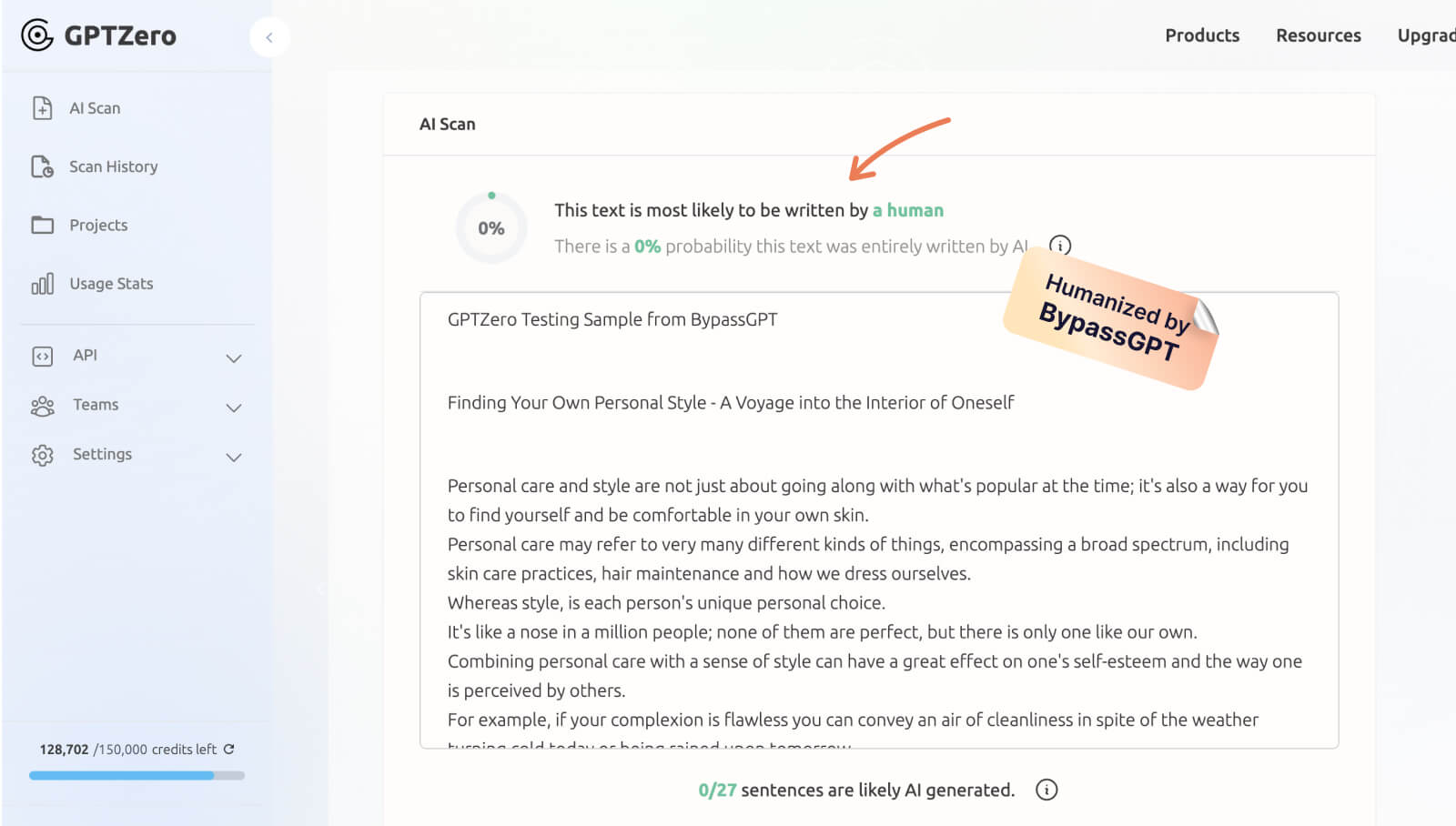
It works by rewriting your content with advanced algorithms. This makes your output 100% undetectable to AI checkers.
But don't let the word “rewrite” scare you. Your content will still maintain its original meaning. It just won't contain any of the characteristics that trigger AI detection.
If, however, you want to slightly tweak the change level, you can use BypassGPT to adjust the bypass mode to better suit the purpose of your content. For instance, you can set the bypass mode to “Fast” for a slight rewrite, or “Creative” for more significant changes in order to bypass more AI detectors.
To see if it actually works, let's put BypassGPT in a real-life test and see if it can truly make AI-generated undetectable and bypass their listed AI detectors.
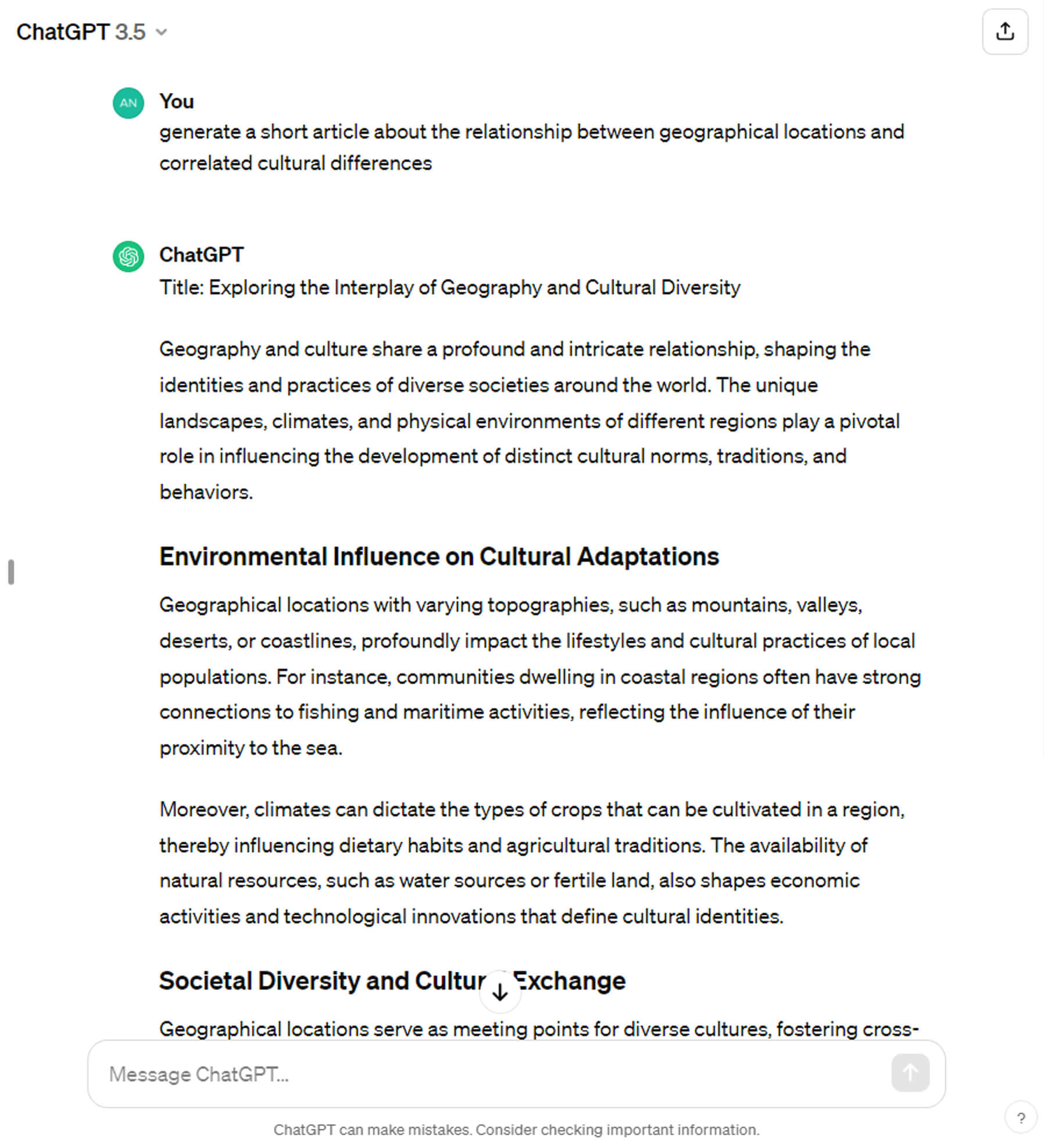
First, I headed over to ChatGPT and asked it to generate a short article about the relationship between geographical locations and correlated cultural differences.
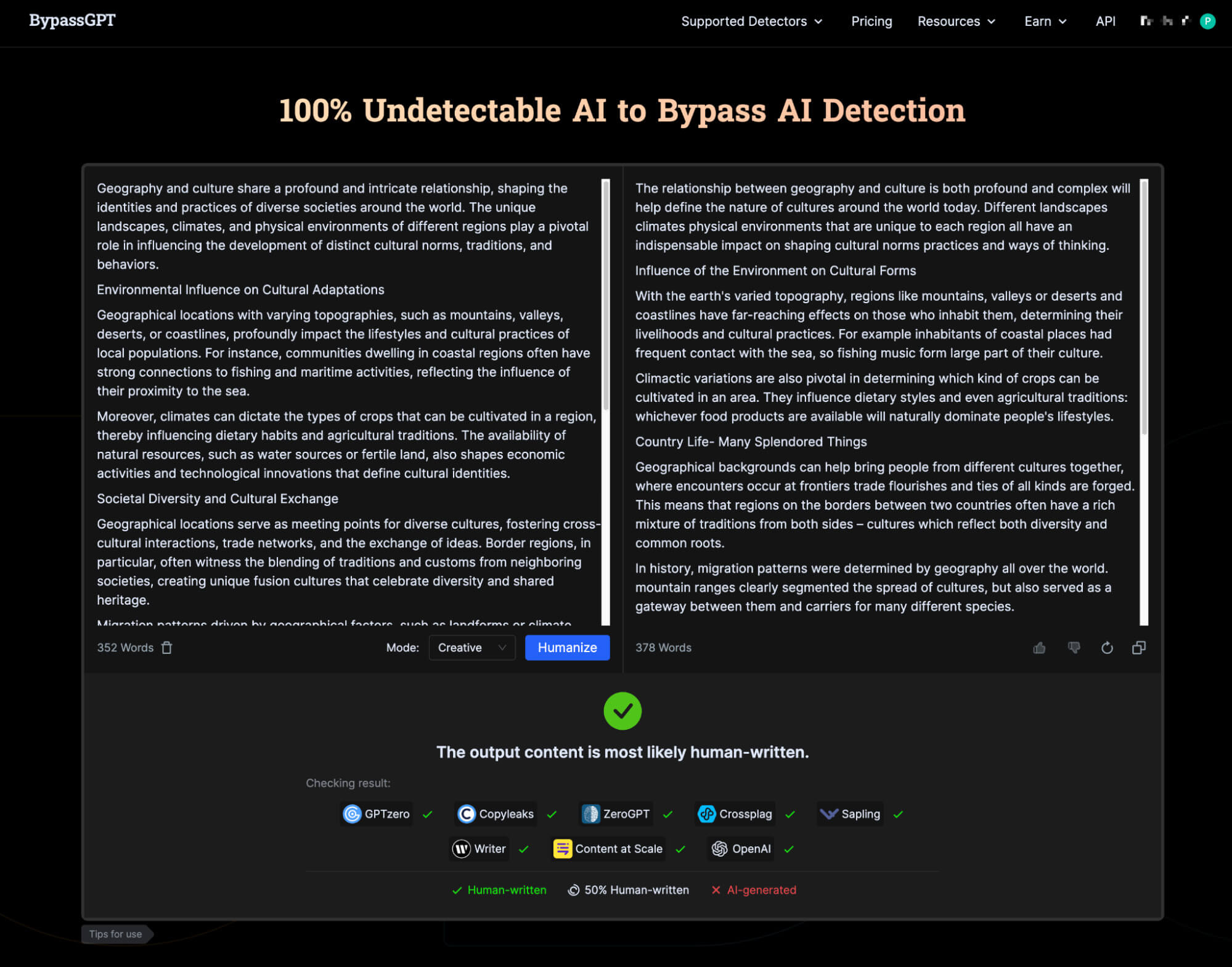
Then, I put the generated content into BypassGPT to humanize the AI text, and this is what I got.
Still, to keep the test even more accurate, I put the humanized content into Originality.ai, GPTZero, and Content at Scale. Here are the results I got.
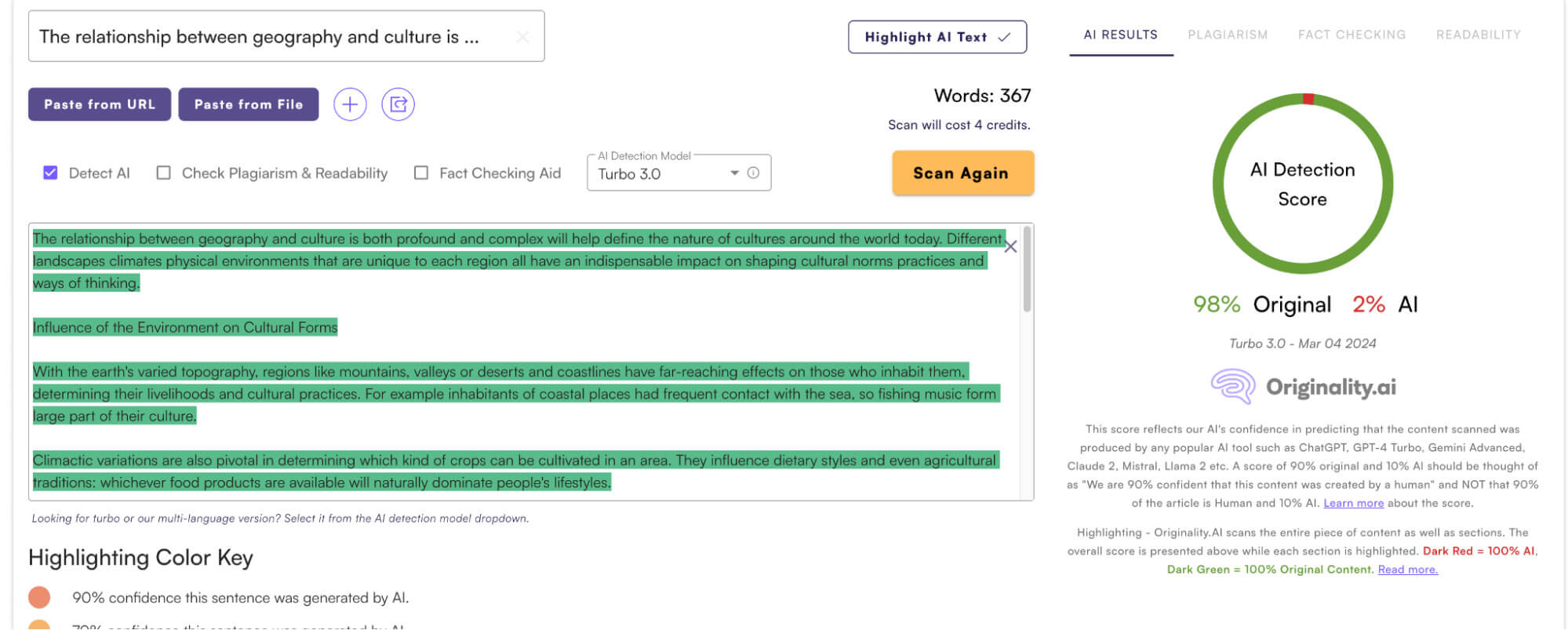
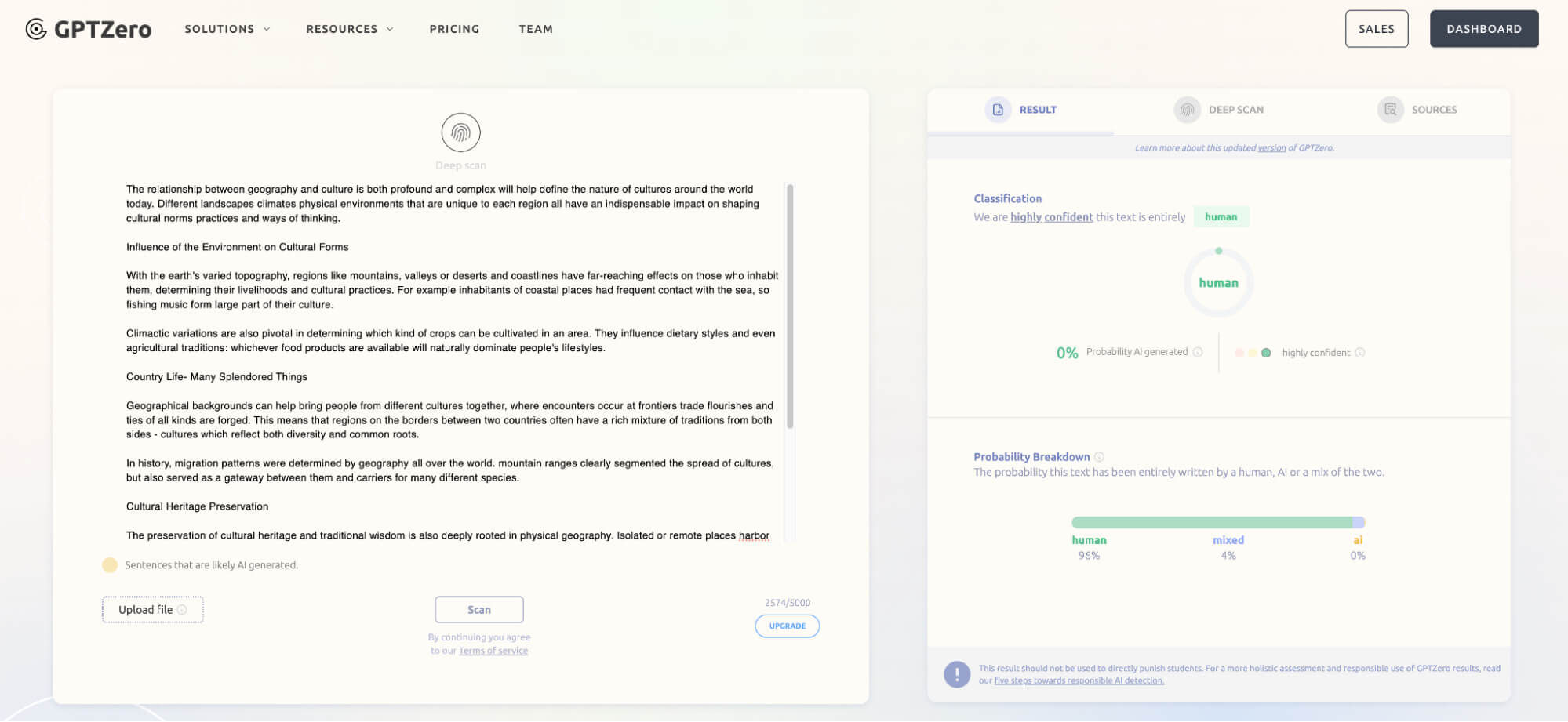
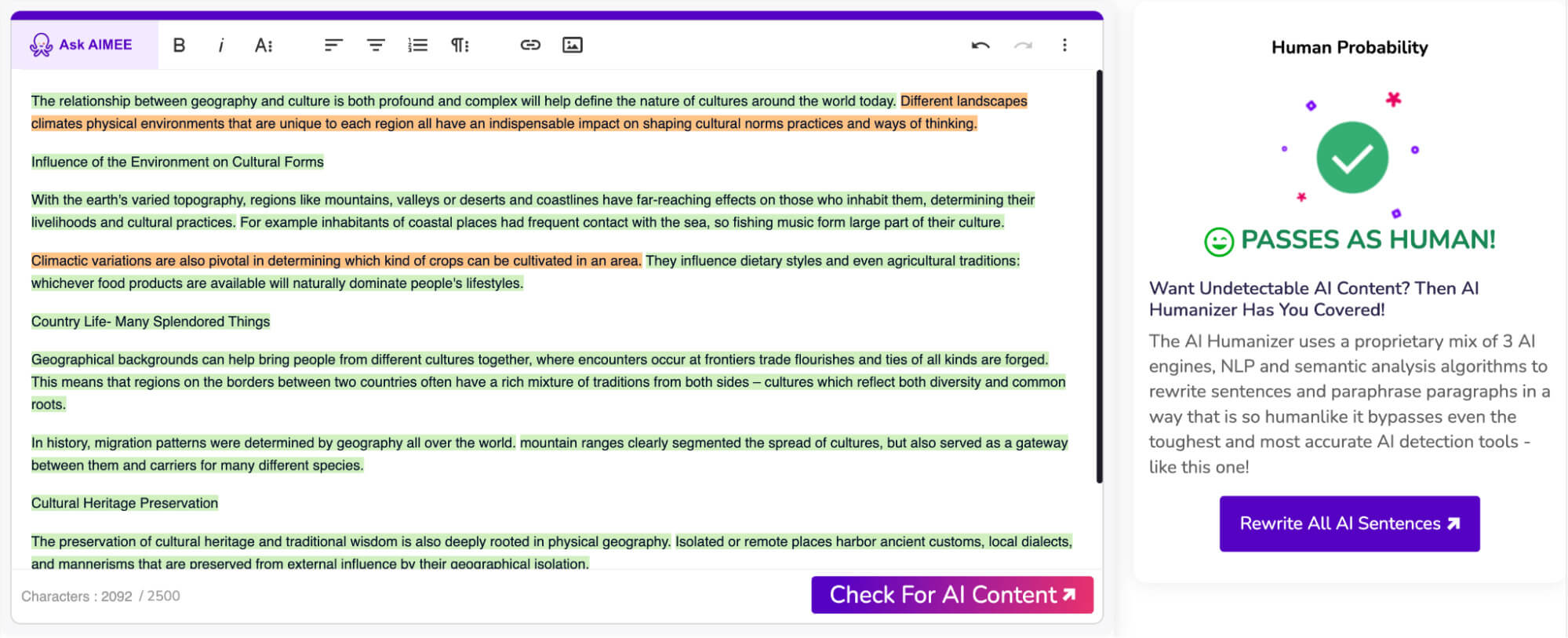
The results impressed me. The content processed by BypassGPT got an outstanding 98% original score from Originality.ai. It also had no problem at all when bypassing GPTZero and Content at Scale.
2. Mix Up Your Sentence Structures
I've noticed that when sentences follow the same length and structure, it's a clear giveaway of AI writing.
If all your sentences start off similarly (like always beginning with the subject), those detectors are likely to flag them as AI-generated.
So, why not shake things up? Try shortening or lengthening your sentences, playing around with their structure, and adding some variety wherever you can.
To test if this approach really makes a difference, I introduced some variety in the text above.
I started some sentences with prepositional phrases, used passive constructions, and mixed in different sentence lengths. Here's how the revised version looks now.
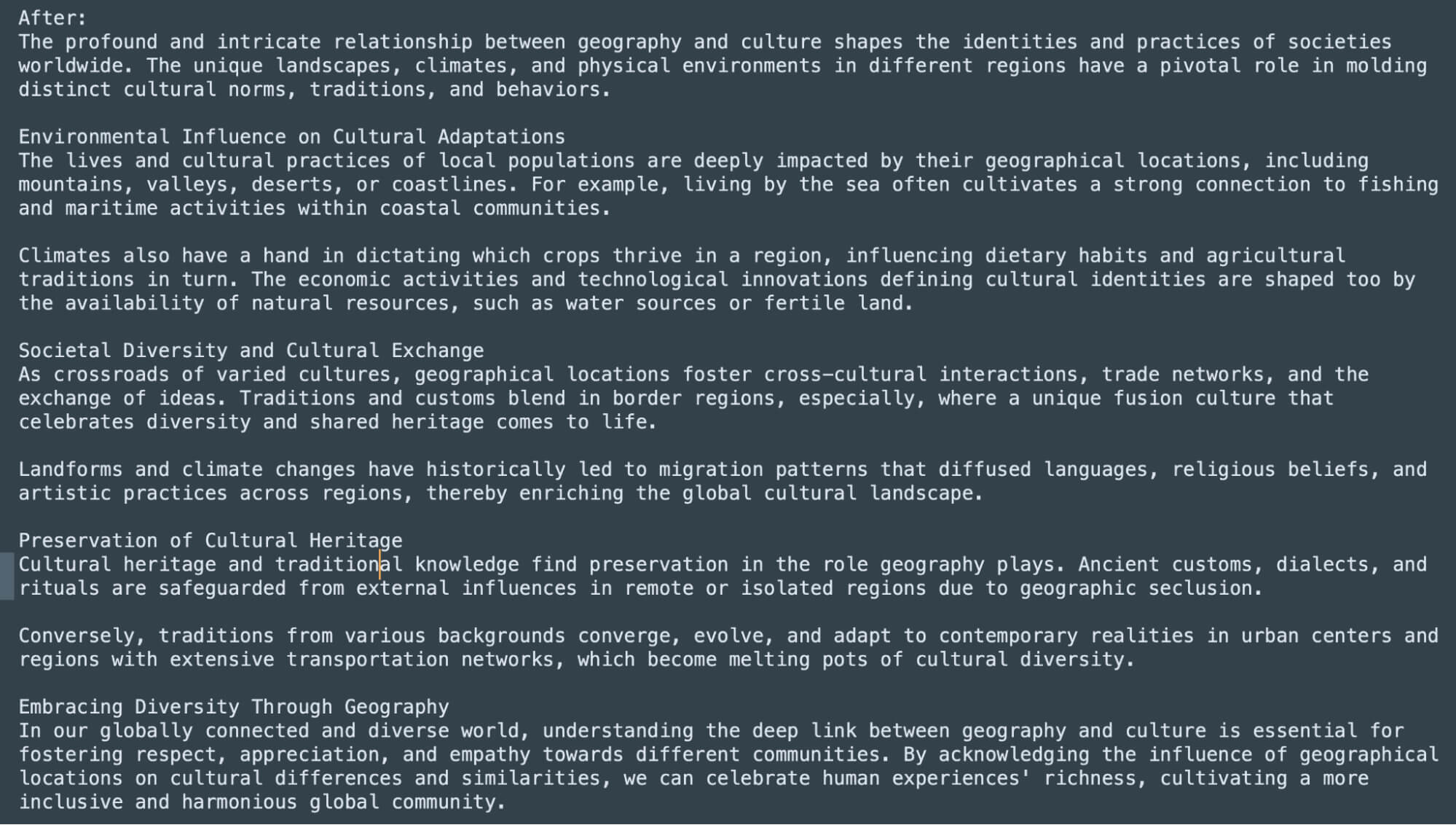
And I put the text in those three detectors.

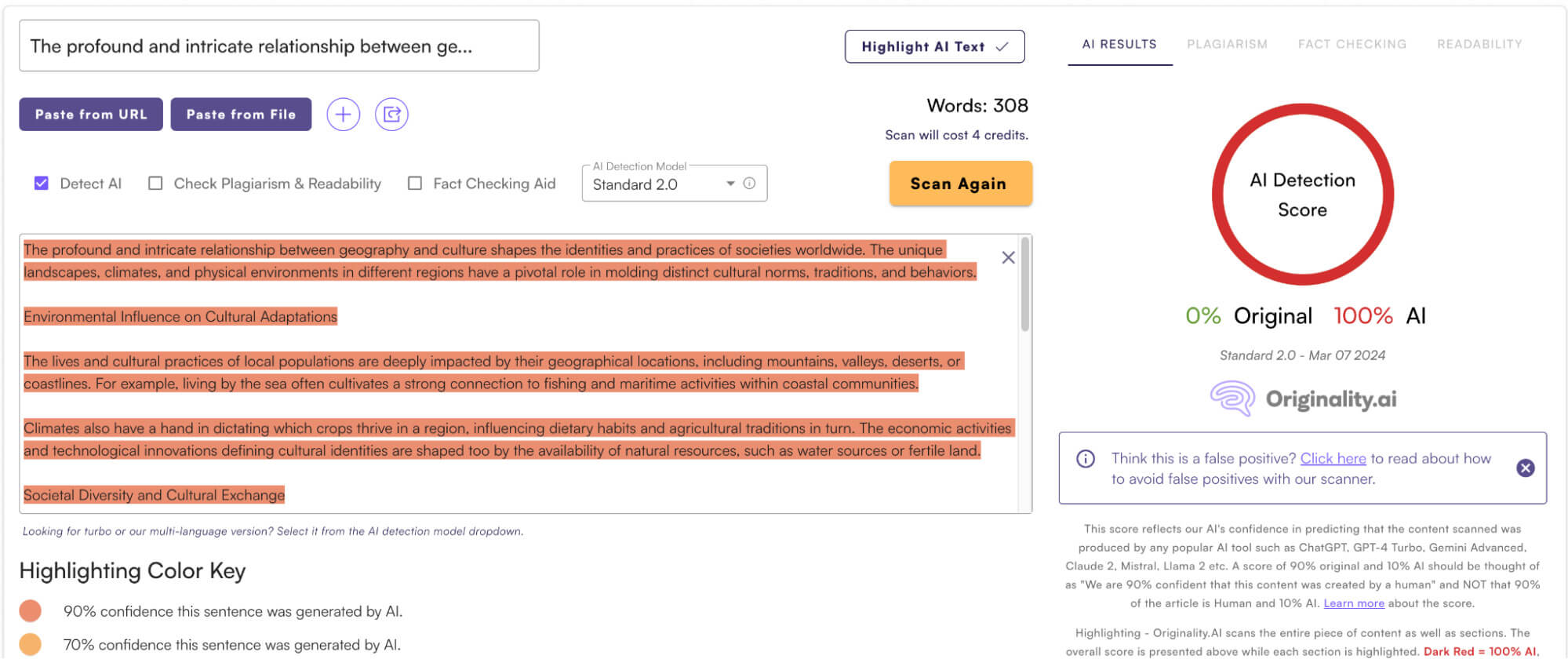
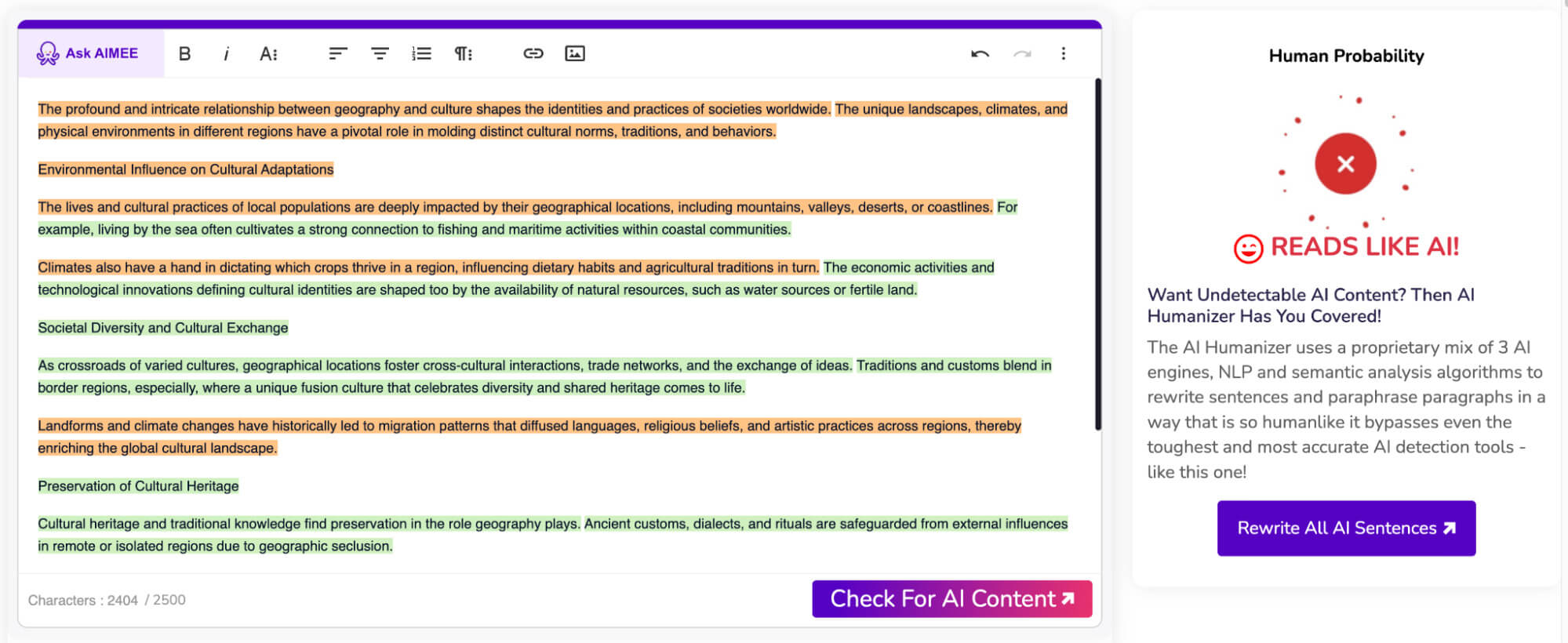
From the results, it seems like this method worked a bit for Content at Scale (I noticed more content marked green). But it still flags the content as AI-generated.
And the other two AI detectors still label the modified version as AI-generated too.
3. Increase Your Content's Diversity
When we talk about diversity, it's not just about sentence structure. It's also super important for your vocabulary and grammar.
If you've been using AI writers for a while, you might have noticed they tend to overuse certain phrases and structures. Our goal should be to eliminate those from your final piece.
Even if you don't catch them right away, mixing up your grammar and throwing in some synonyms can help humanize your AI content.
I made a few changes to increase the diversity of expression in my writing. I steered clear of relying too much on specific phrases and structures that can take away from the originality and richness of the content. Let's see how well this approach works!
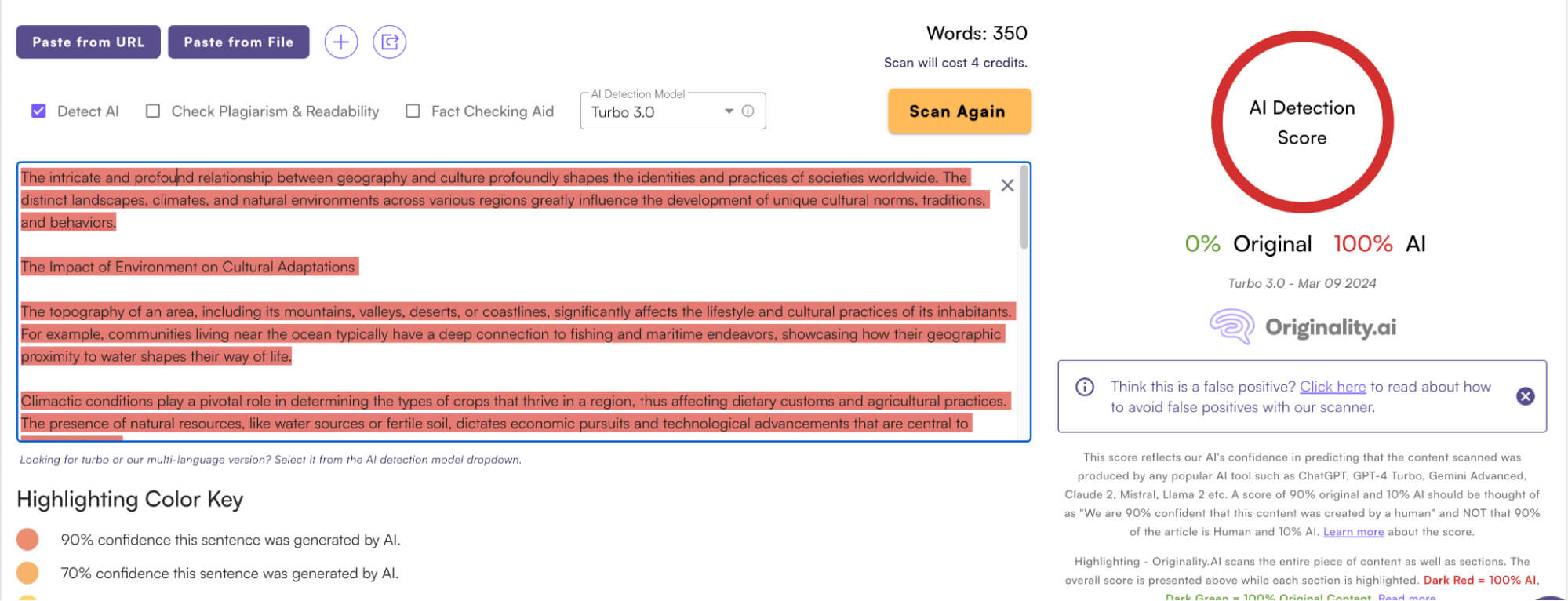
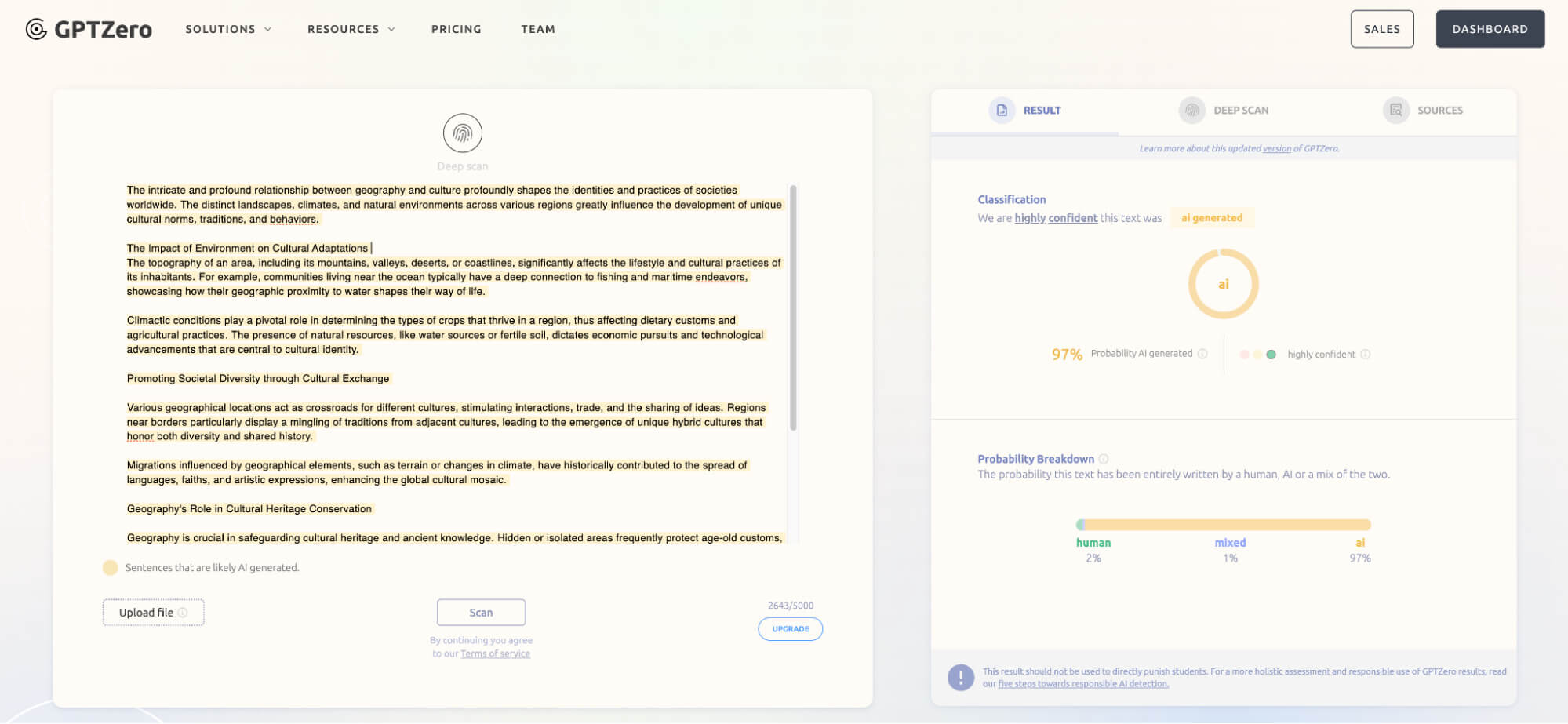
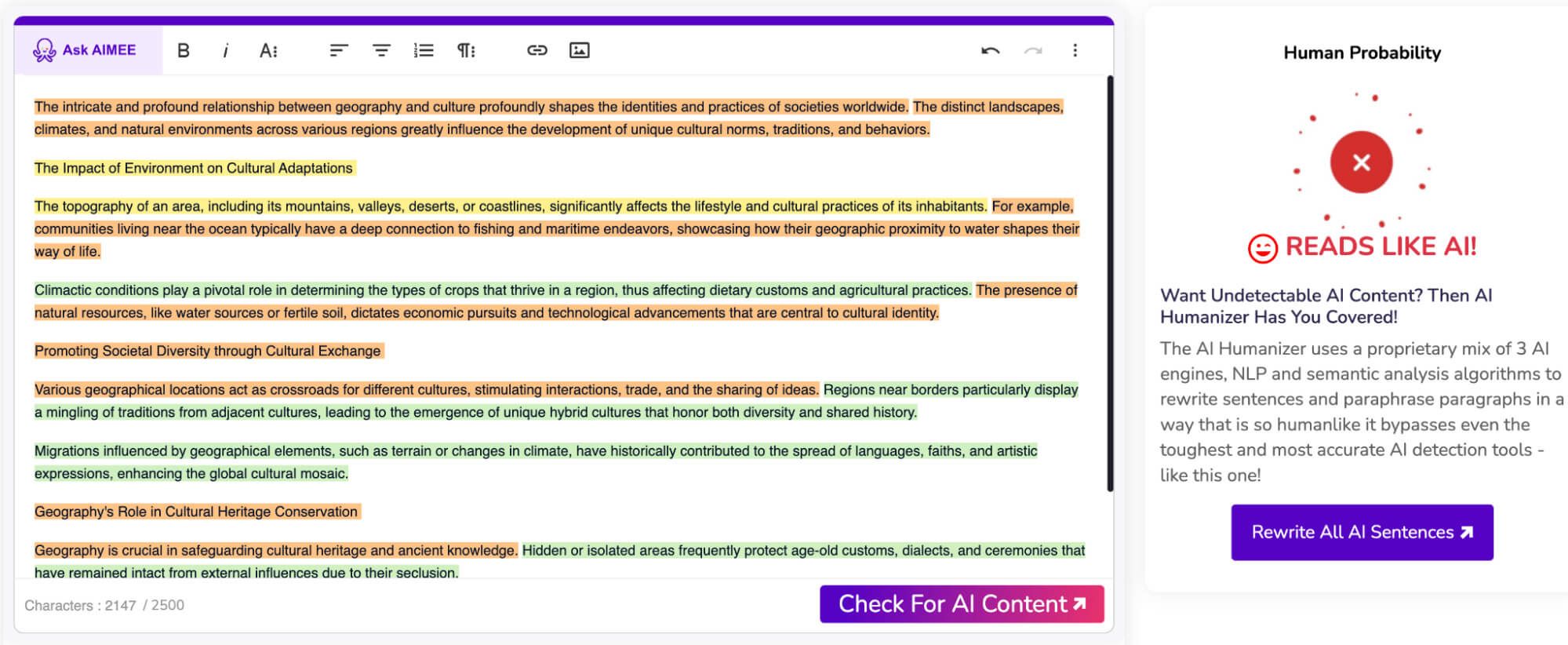
Unfortunately, it seems that some of the changes I made weren't enough to fool the AI detectors.
While I noticed a few green marks in the scan result from Content at Scale, the content was still being marked as AI-generated.
4. Include Search Keywords Naturally
You've probably learned that keyword stuffing is a big no-no in SEO. But some say it can be used to make ChatGPT text undetectable.
Weaving keywords into your content in a natural way can help improve your search engine rankings. And it is said to be a way to optimize texts so it raises fewer red flags.
To see if this works, I added keywords to the text like "geography and culture," "cultural adaptations," and "preservation of cultural heritage" (in the context of how environmental factors shape societal norms and practices). I'm curious to see if this will actually have an impact.
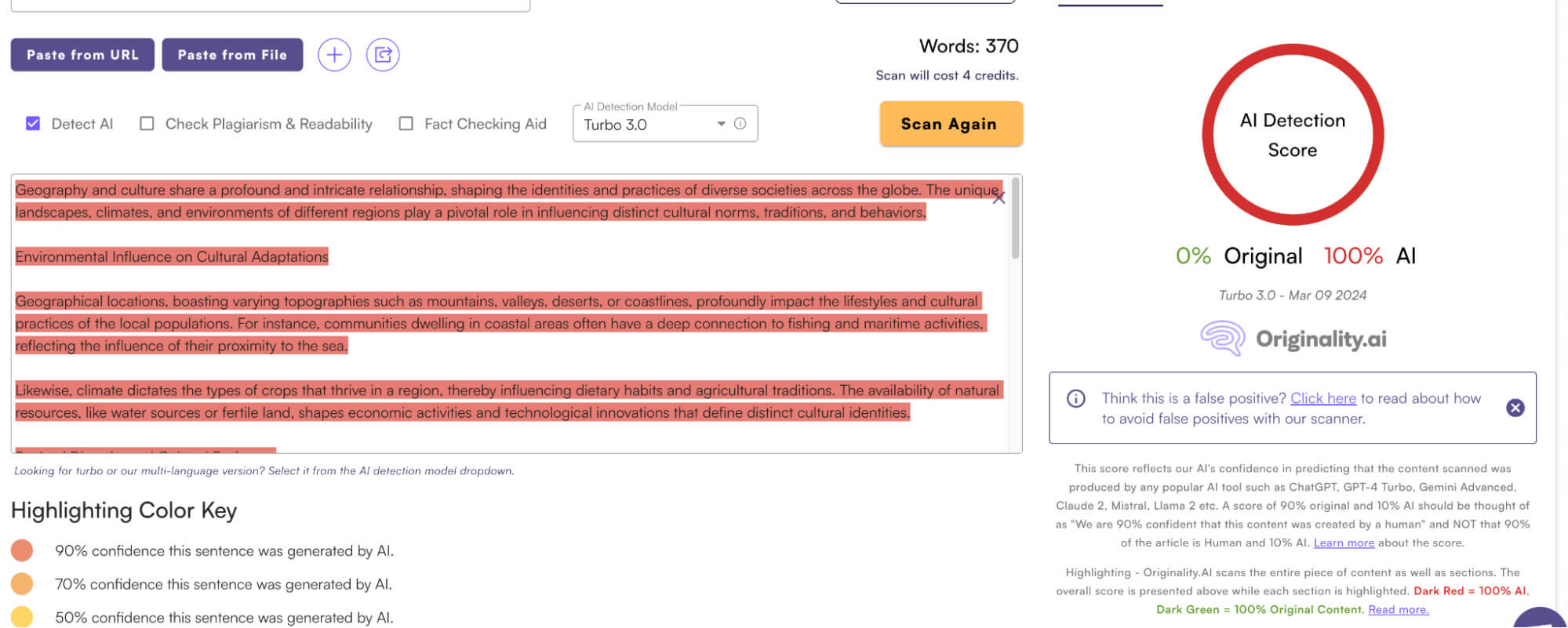

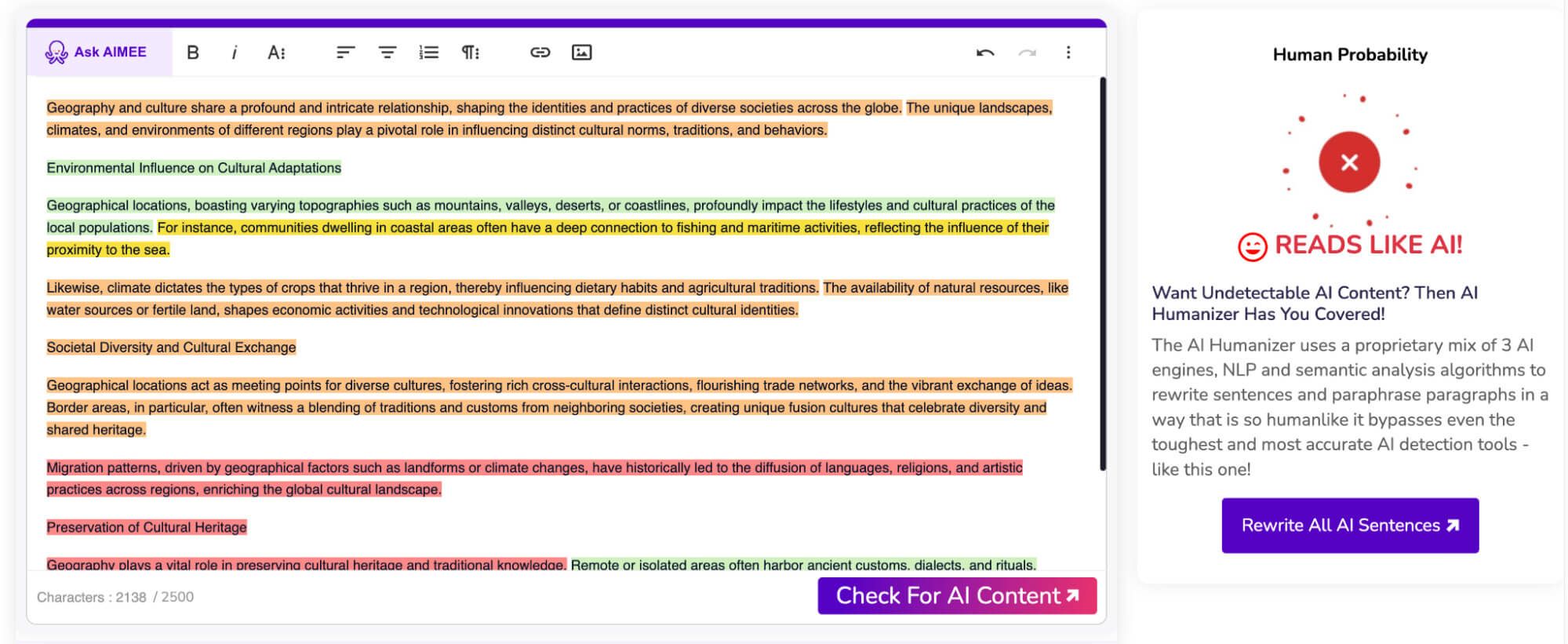
I have to be honest—it looks like just adding keywords didn't change the AI-writing score at all. All three detectors still flagged the processed content as AI-generated. It's clear that you need to combine this method with others for better results.
5. Insert Contextual Collocations
AI sometimes include phrases that are correct but just don't sound right together. It's a good idea to look through your AI-generated writing and find any awkward phrases so you can fix them.
By adding collocations—words that naturally fit together—you can help your content avoid being flagged as AI-written.
I made some changes to make the test text easier to read and more relevant. My goal was to get rid of phrases that, while correct, felt out of place.
For example, using phrases like “deep-seated maritime culture” and “agricultural blueprint” can help the text sound more natural and engaging.
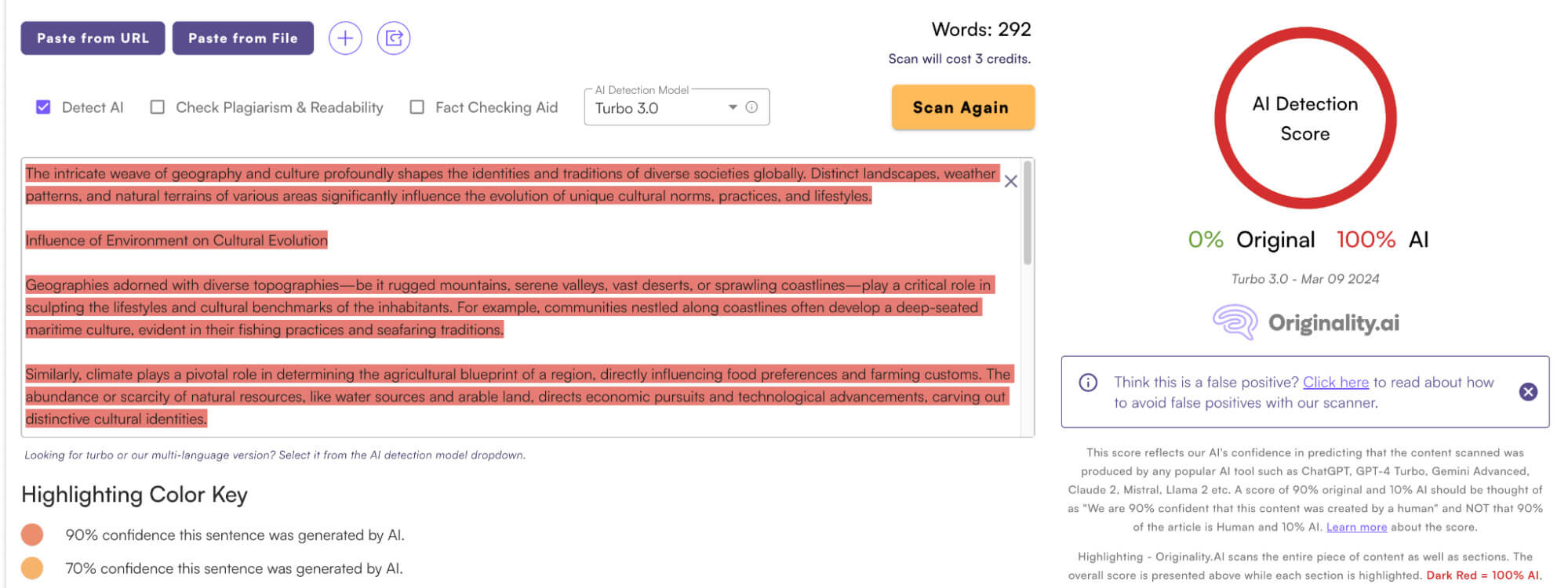
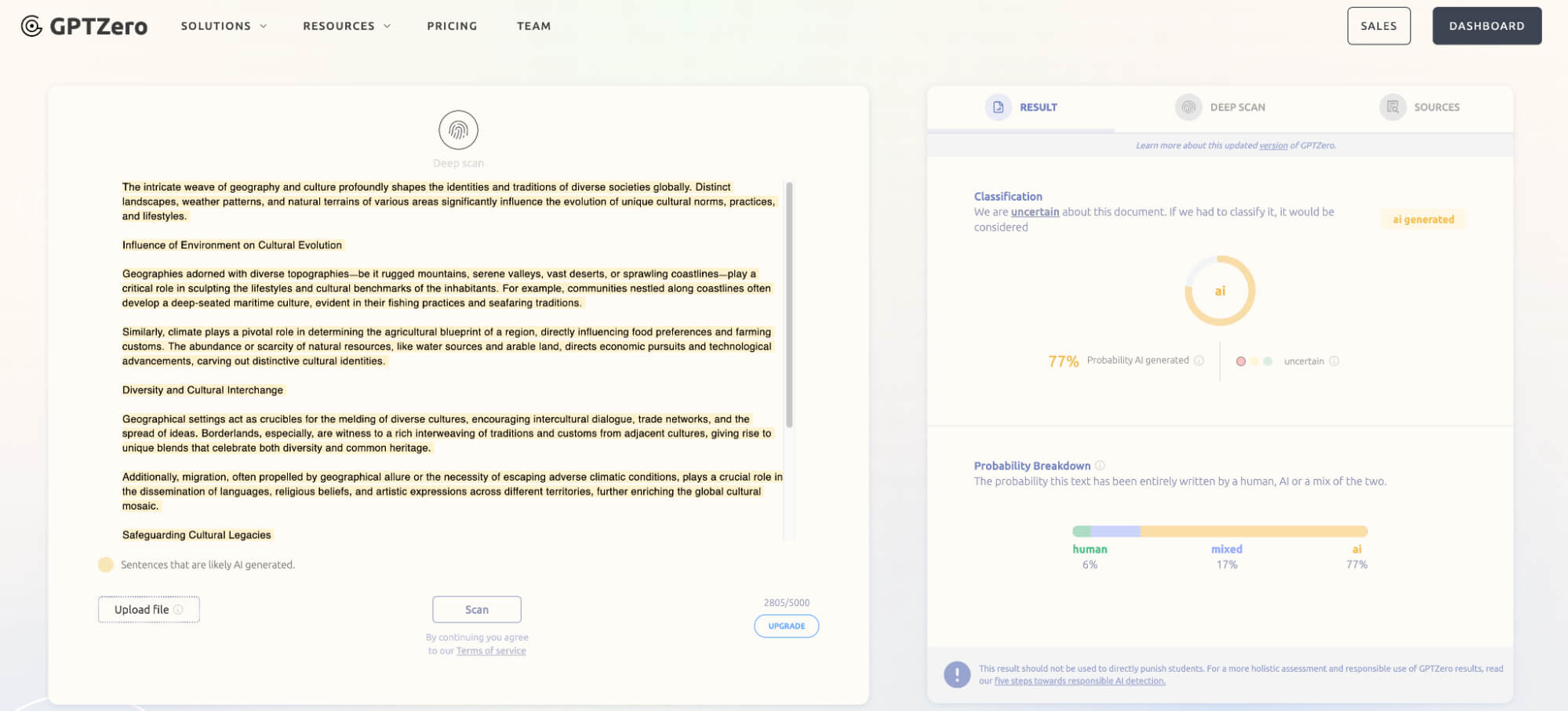
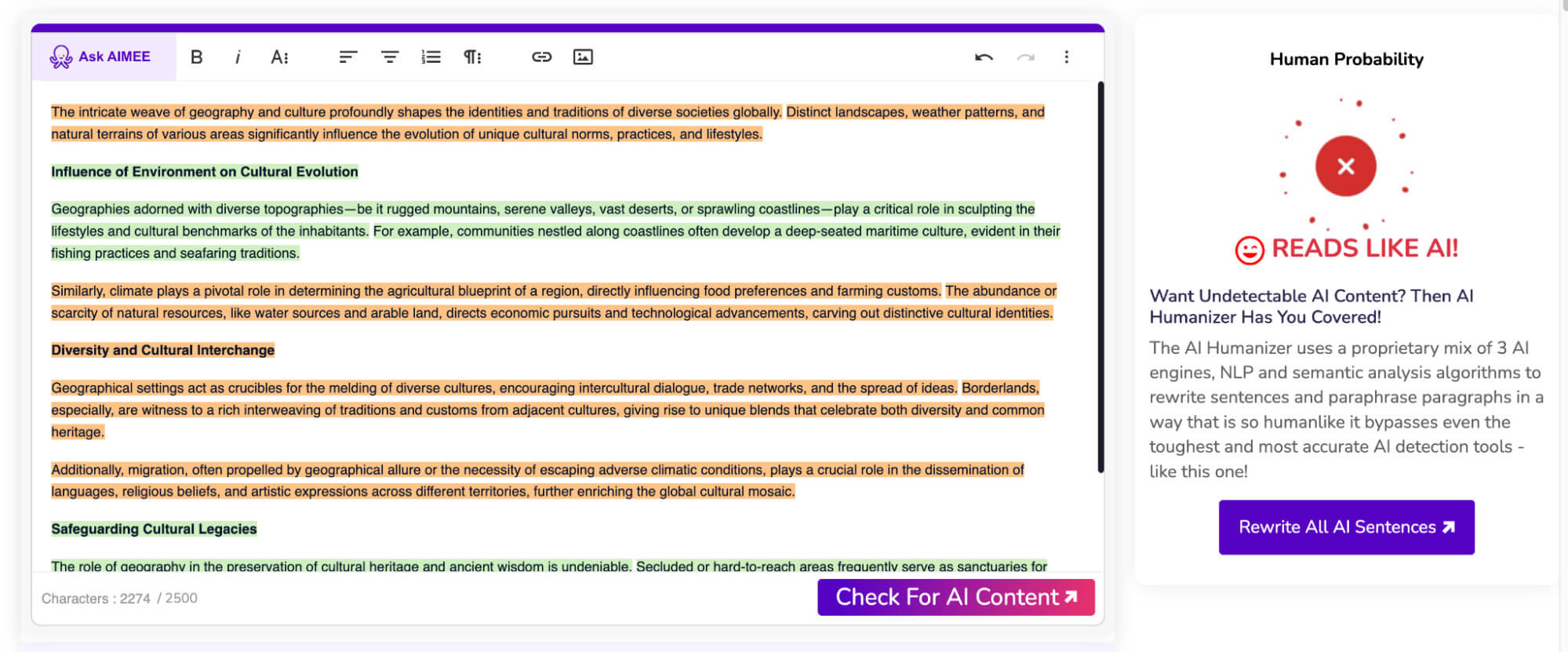
The good news is that this approach worked for GPTZero and Content at Scale! The changes I made actually lowered the AI score on those platforms, with less content marked in red by Content at Scale. However, Originality still flagged it as AI-generated.
6. Be Ultra Specific
I've found that AI writing tools often create content that is pretty general and vague. They usually don't include the specific examples and details that make human writing interesting.
To avoid being detected as AI content, it's smart to read through your text and add relevant details that make it feel more real. Sharing a personal story can also make your writing more relatable.
Let's see how being specific works against AI detectors.
In my edits for this test, I focused on adding specific details and authenticity to the article, and showed the rich experiences of people.
For example, I mentioned the survival skills of the Inuit and the unique fusion food found in Ciudad Juárez and El Paso. Here's the revised version of the article:
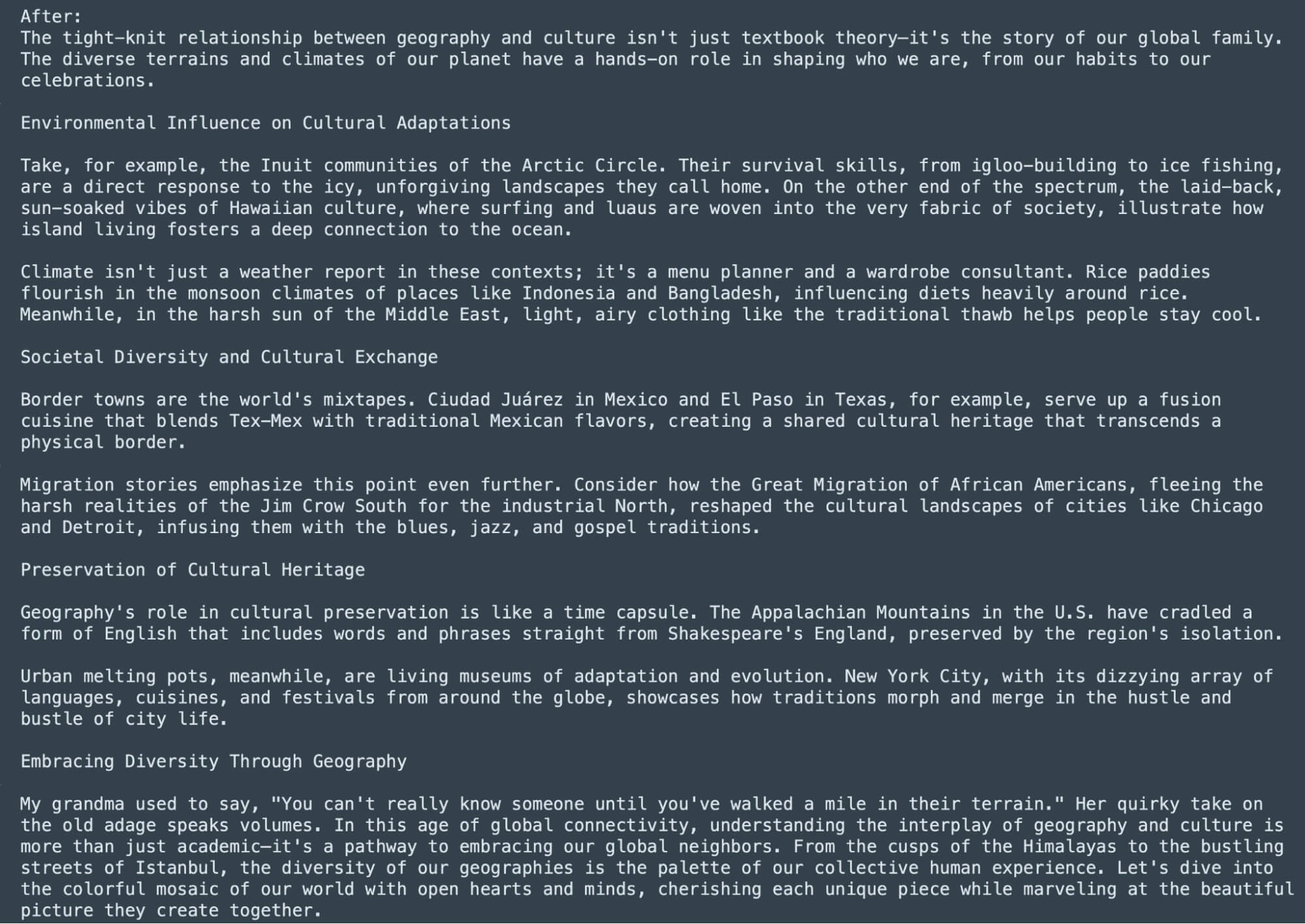
Now, let's check the results from the AI detectors.
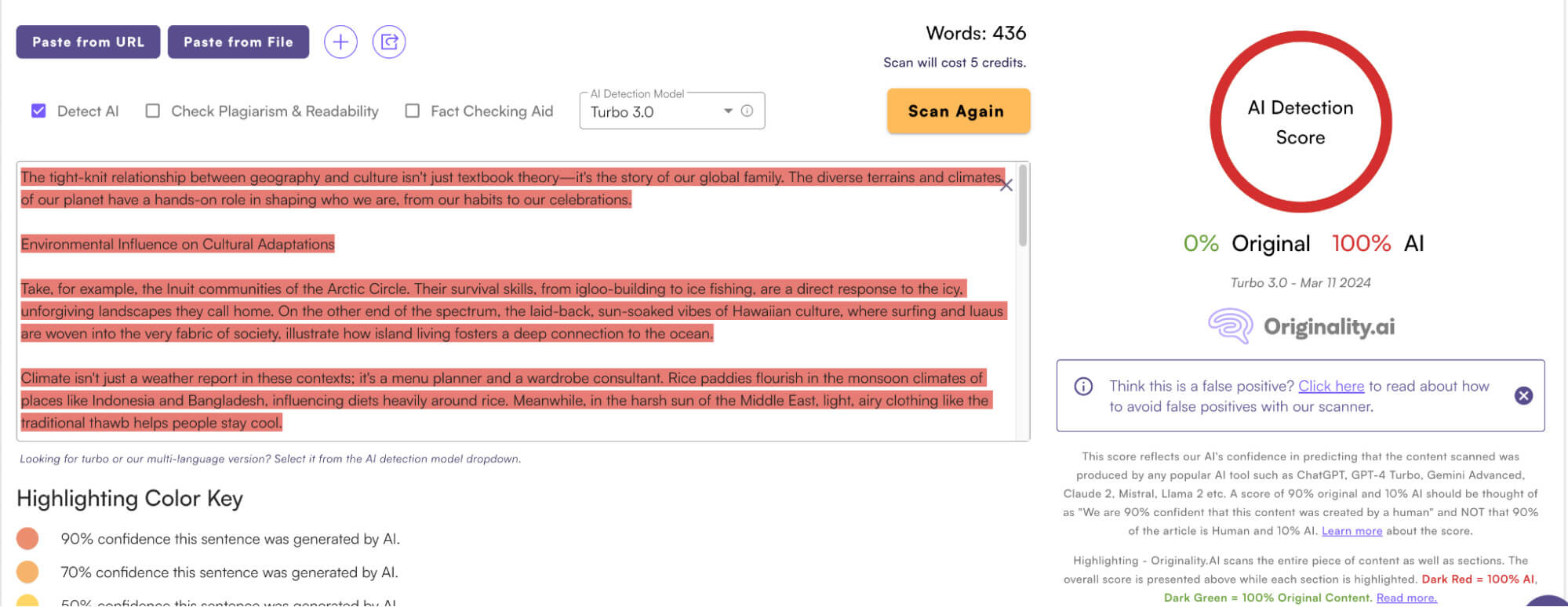
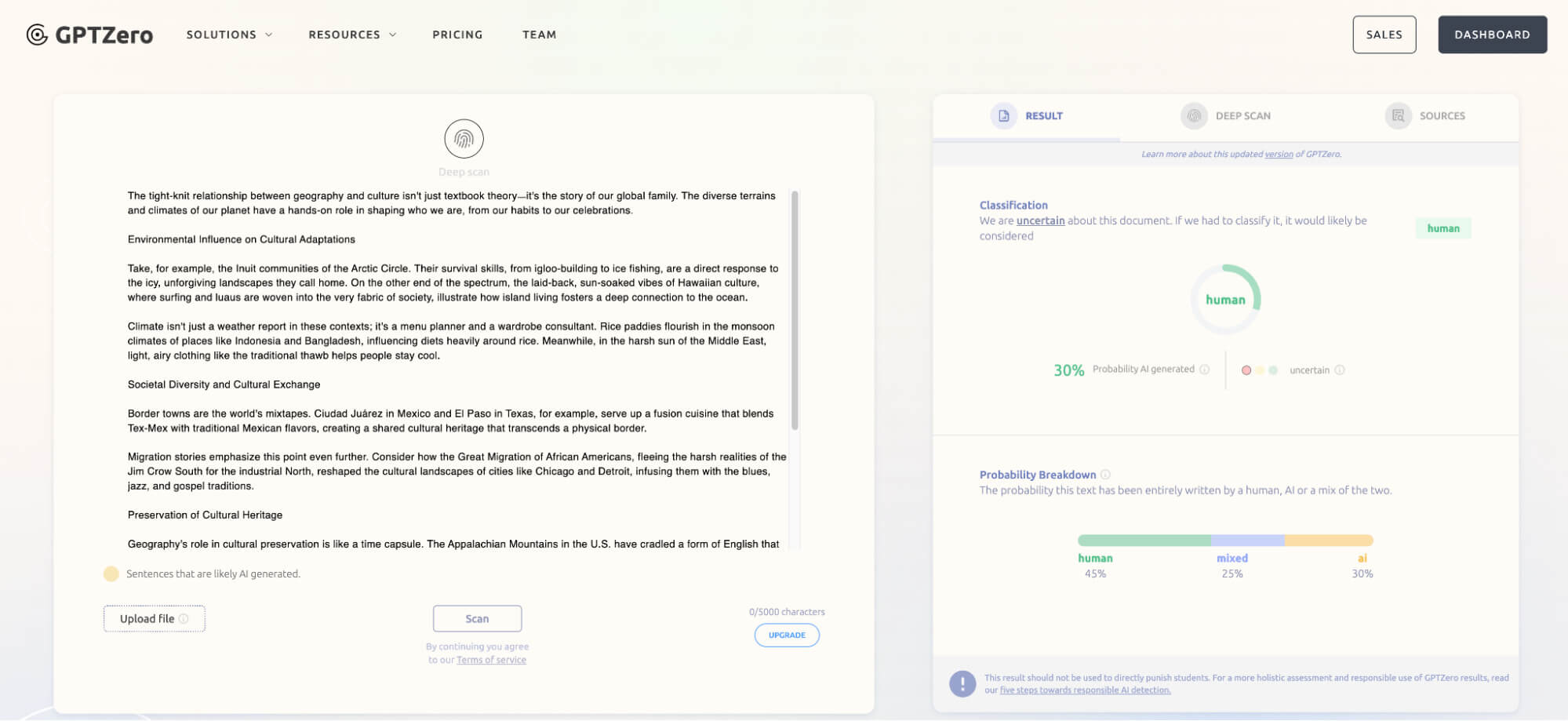
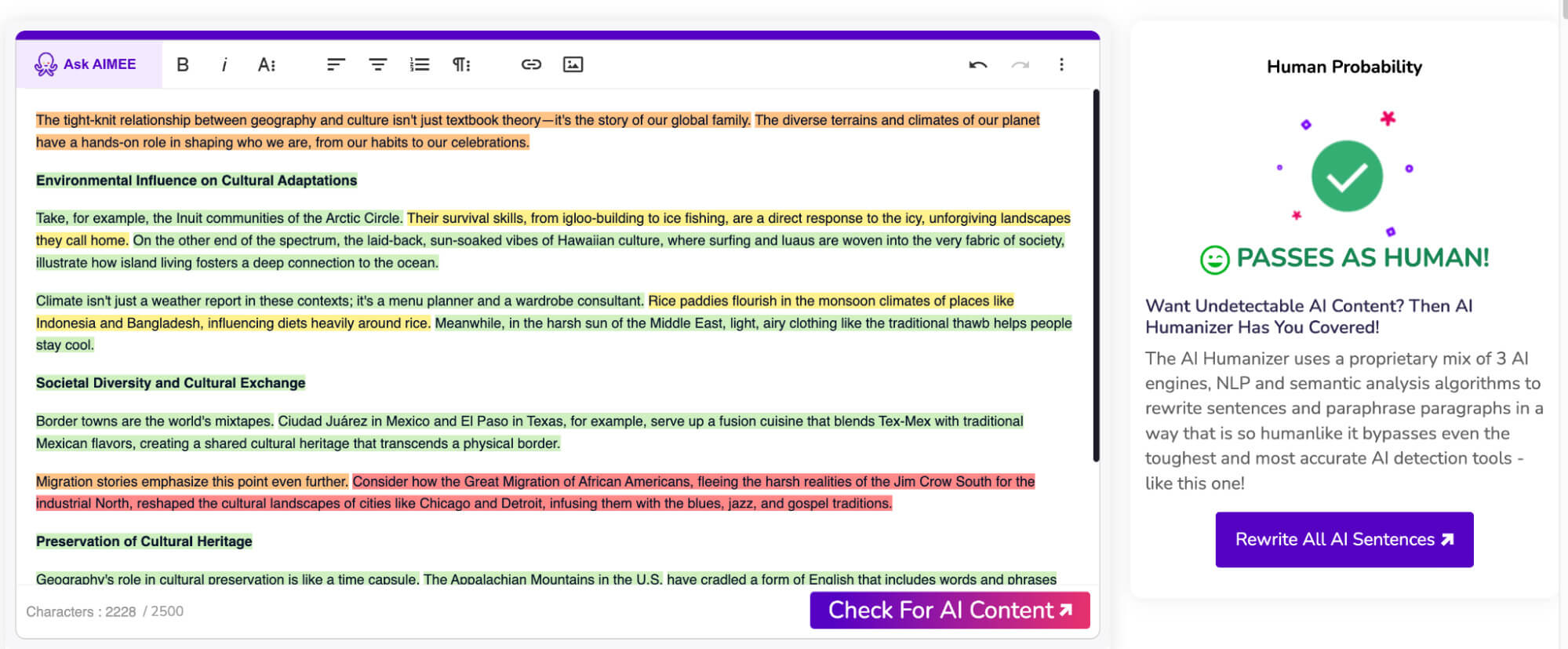
It seems like this strategy worked for GPTZero and Content at Scale! Both detectors suggested that there's a good chance the content was written by a human.
However, this level of change wasn't enough to fool Originality.ai. If you want to get past Originality, you might need to make even more changes to humanize the text.
7. Incorporate Distinctively Human Elements
When we try to make AI-written content feel more human, we shouldn't just stop at adding personal stories. We can also include things that are uniquely human, like casual language or humor.
Even though AI writing tools are advanced, they can't copy the small details of human writing that make it relatable and fun to read.
To test this method, I made several changes to add those distinctively human elements.
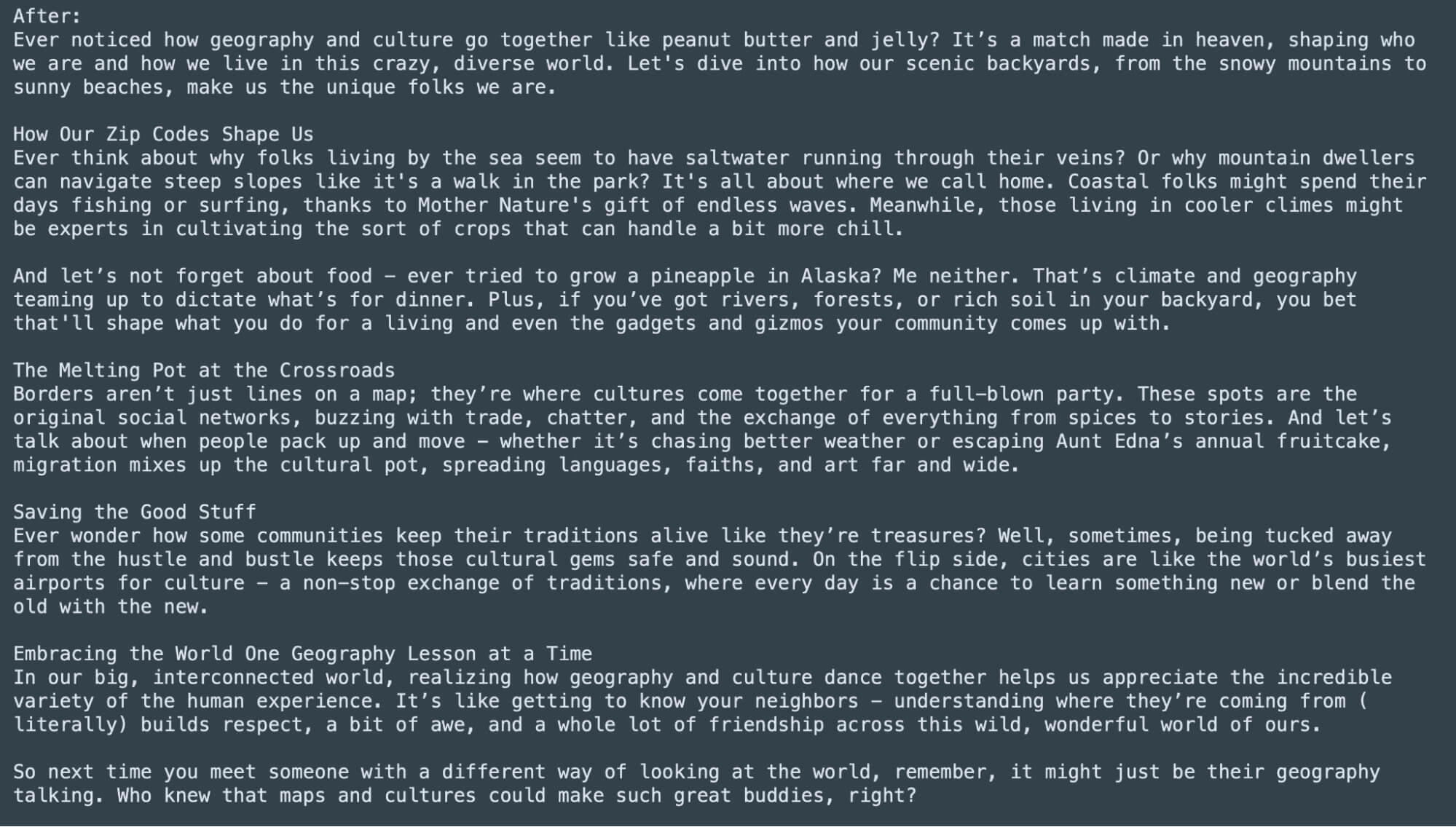
I included casual phrases, a bit of humor, and some quirks that only humans have. These extra touches can help turn a piece of AI-like text into a friendly, engaging conversation.
Here's the final result:
Let's see if it works.
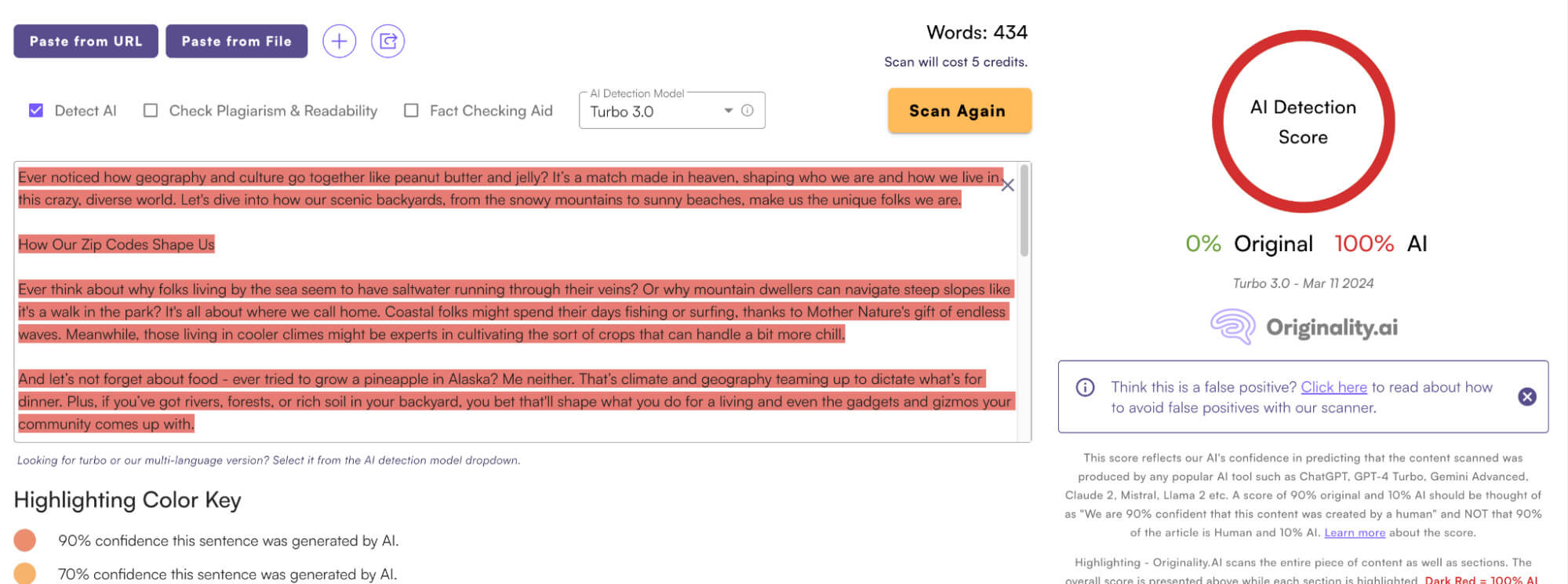
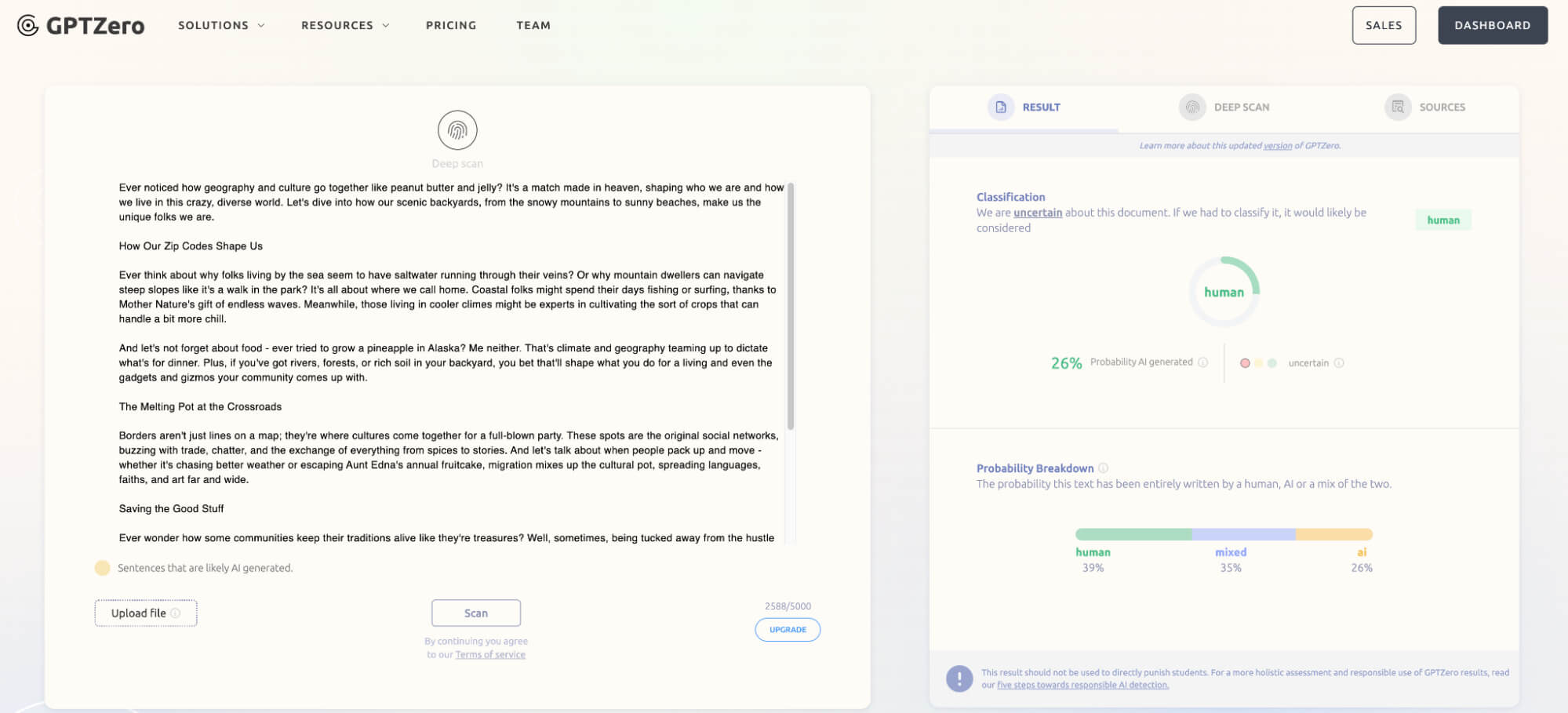
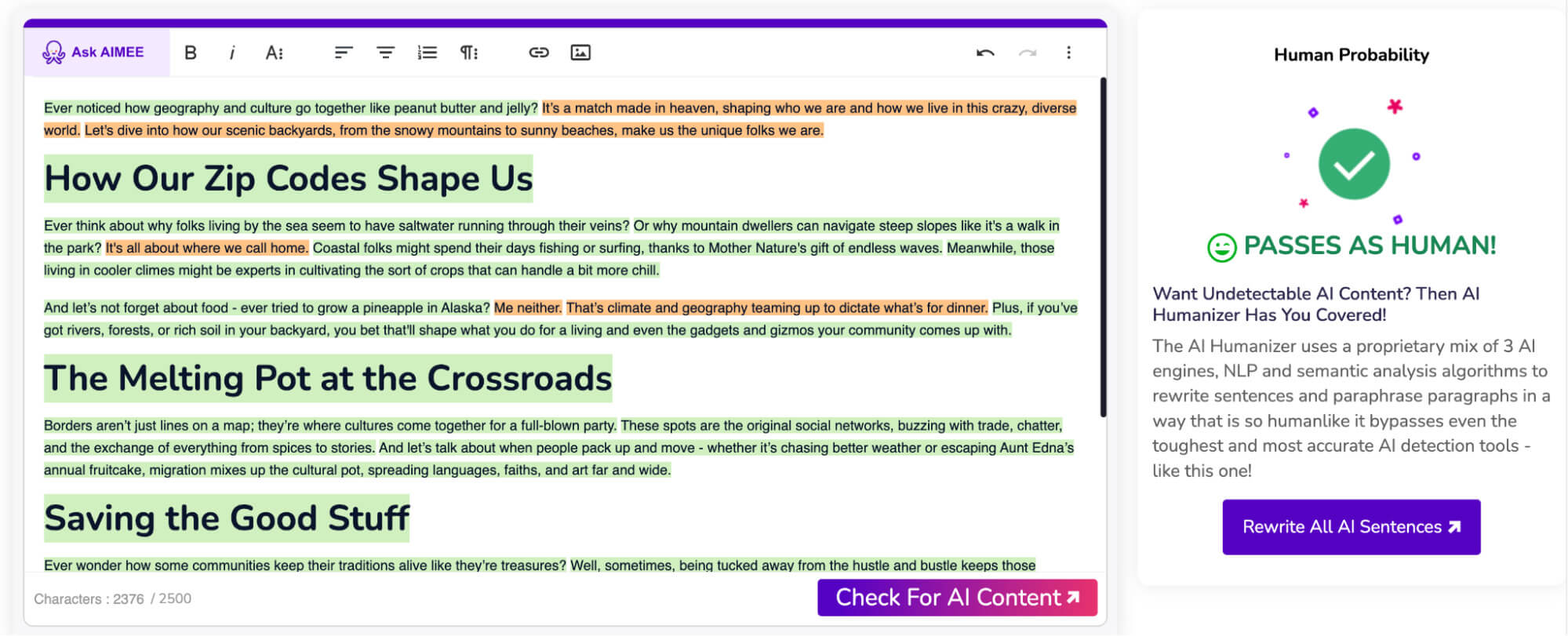
Once again, the way we adjusted the text is working for GPTZero and Content at Scale. Both AI detectors think the content is likely written by humans. However, it still isn't working for Originality.ai.
8. Simplify the Writing
AI content writing tools often use long and complicated sentences that come off as robotic. Keeping things simple is a great way to bypass AI detectors.
So, it's helpful to break long sentences into shorter ones, swap out overly technical words, and make confusing phrases easier to understand.
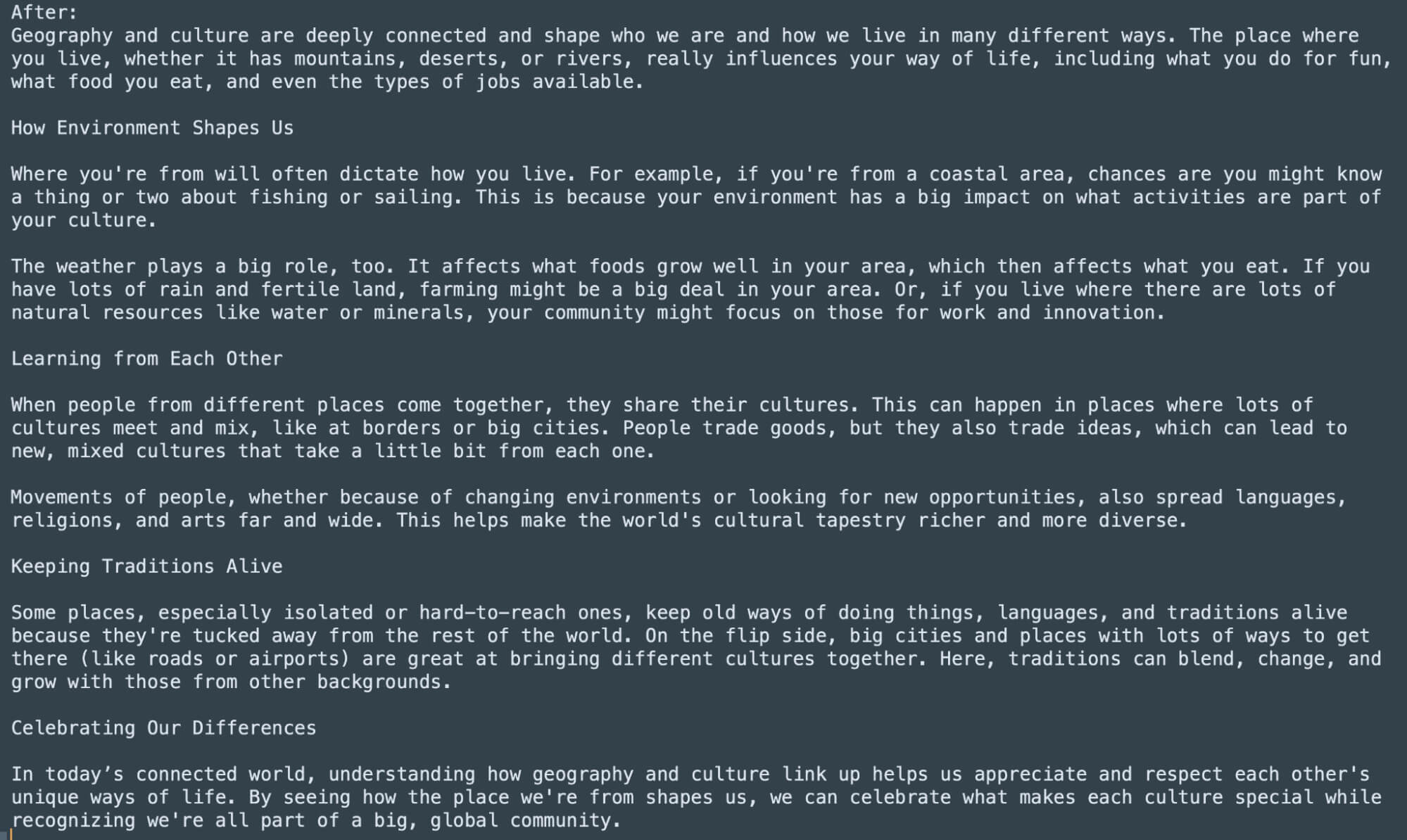
In my revision this time, I aimed to make the writing feel more accessible and human.
For example, I changed phrases like "profound and intricate relationship" to "deeply connected," which simplifies the language without losing the meaning. Also, I broke down complex ideas into relatable examples, like how geography affects food and jobs.
Here's the result of our changes:
Let's test the content with the AI detectors:
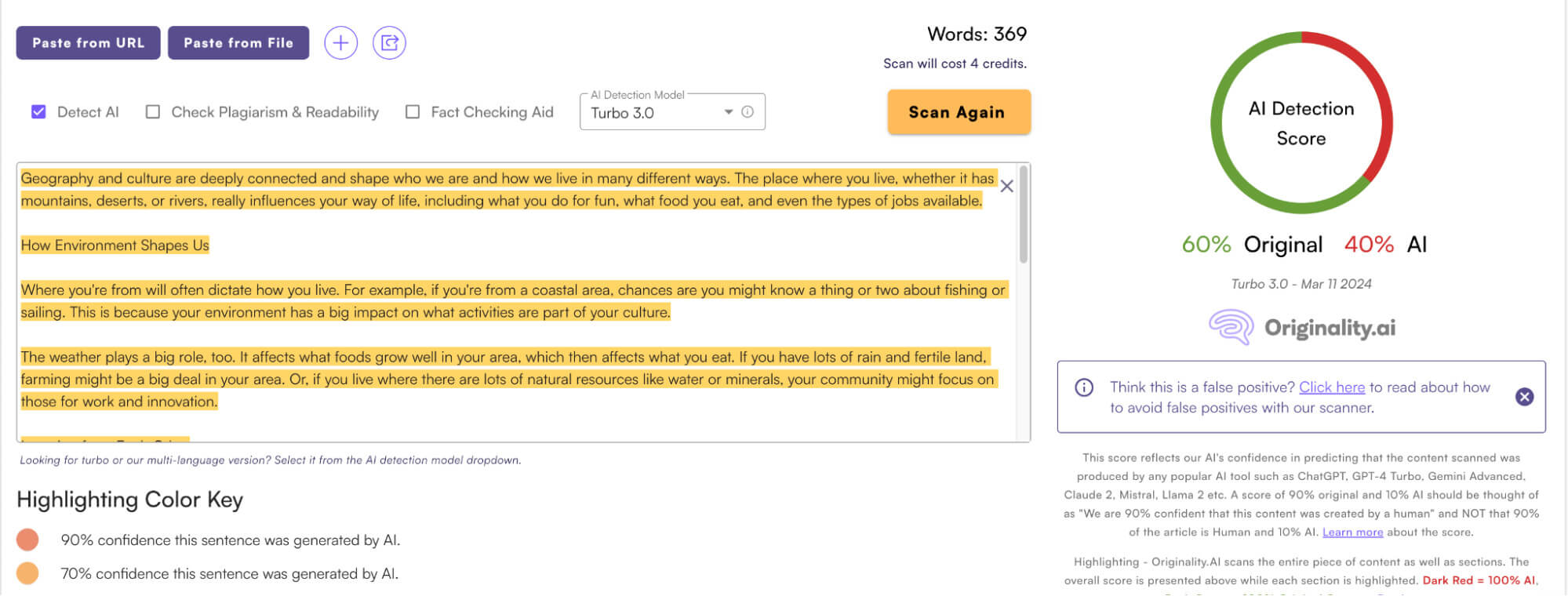
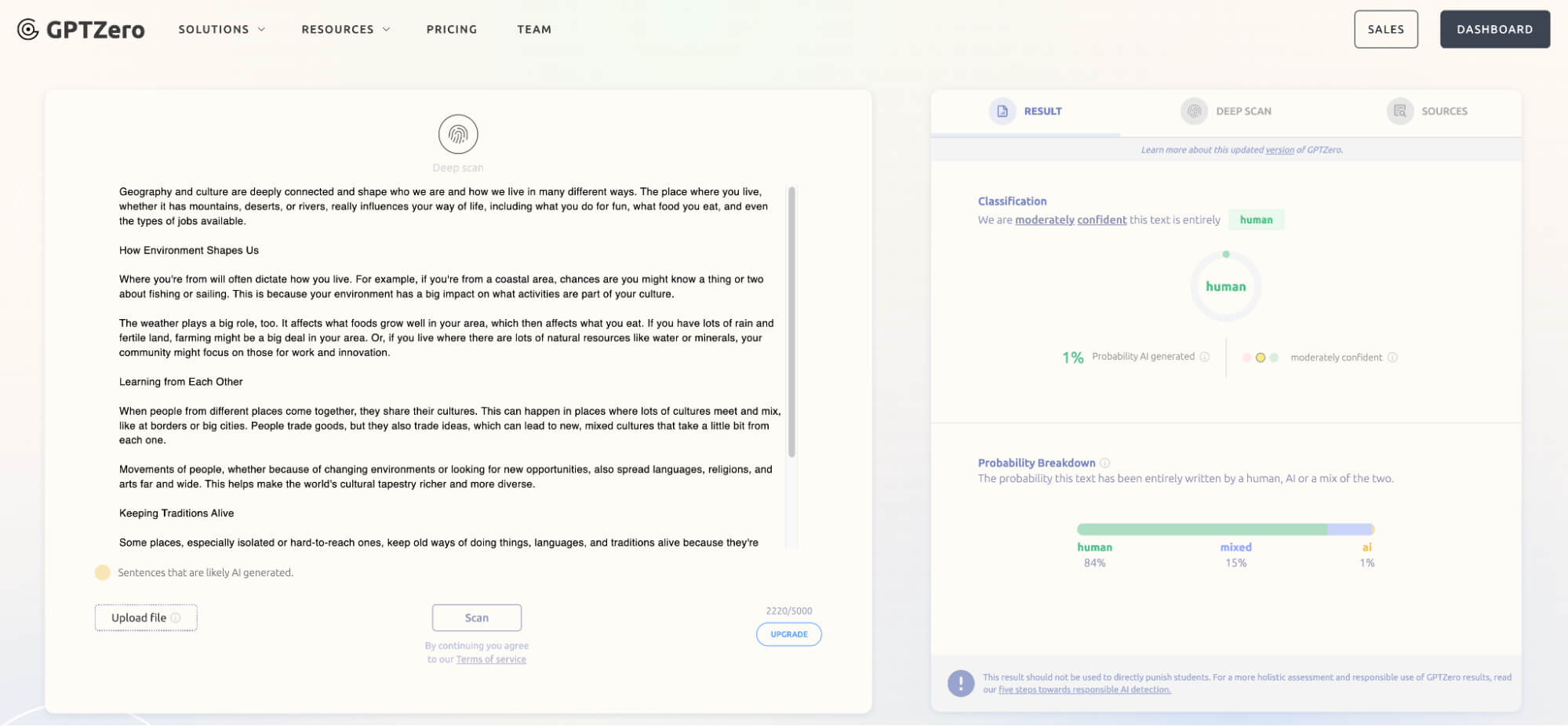
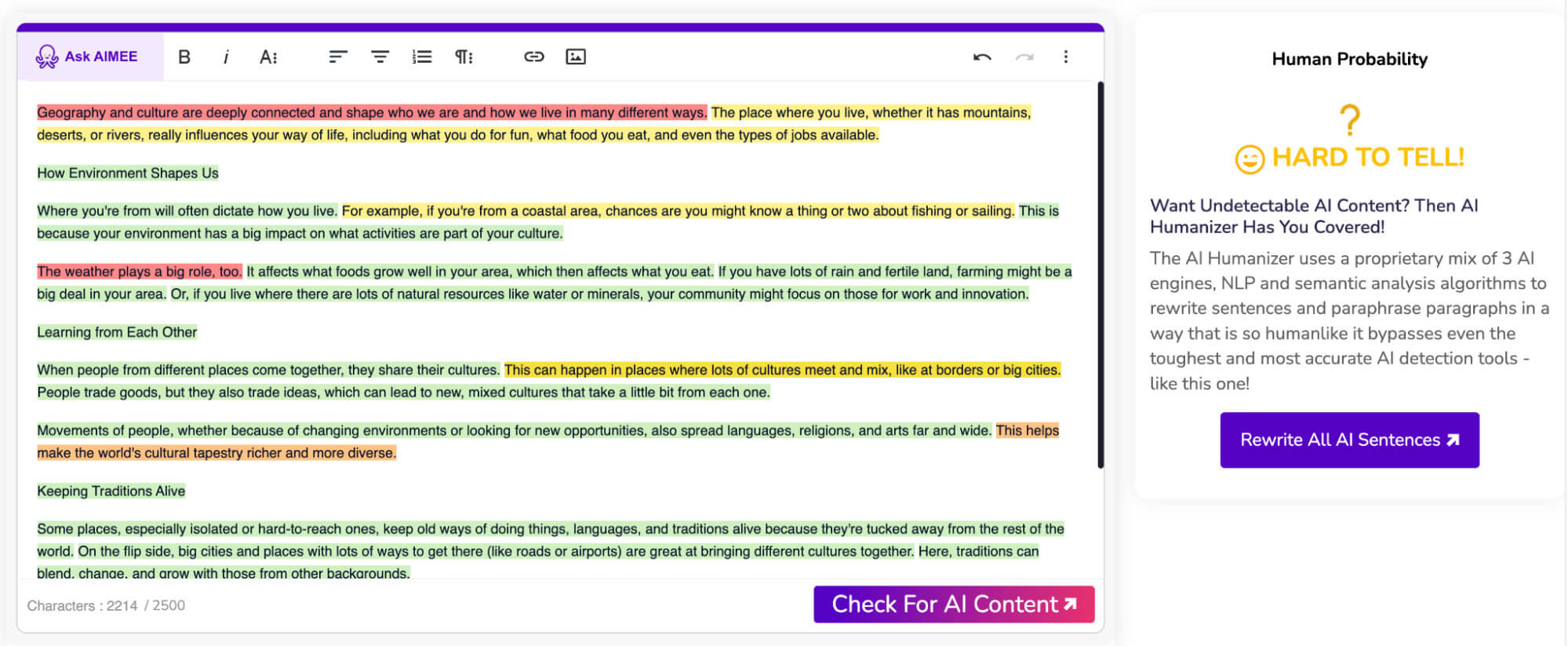
This method gave me mixed results. Originality.ai thinks the content is 60% human, GPTZero thinks it's 84% human-written, and I got a hard-to-tell result from Content at Scale.
So, while simplifying your AI text can lead to different results with various AI detectors, this approach does seem to work to some extent.
But simplifying content is always a good way to make complex ideas easier to understand and improve how readable any text is!
9. Use Active Voices
Another reason AI writing can feel robotic is because it often uses the passive voice too much. They don't write from human perspectives.
I've found that switching to an active voice is a commonly recommended way to bypass AI detectors. Plus, using active voice can greatly improve how readable and engaging your writing is, which is great for your readers.
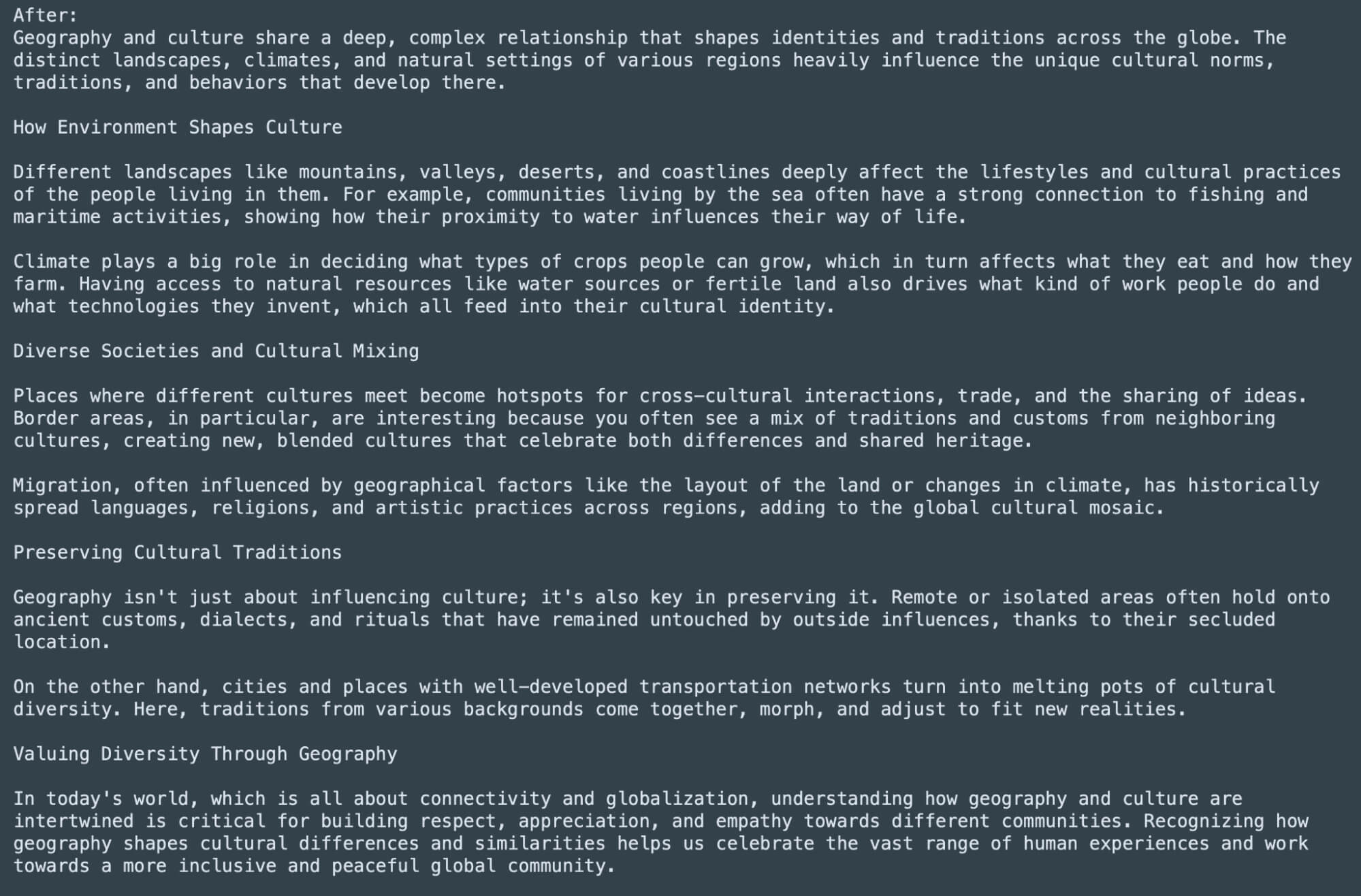
To test this, I made several changes to use more active voice in our article. For example, instead of saying "traditions and customs from neighboring societies are often witnessed blending", I said "border areas often blend traditions and customs from neighboring societies."
Here's the final look at the revision:
Will this work? Let's find out.
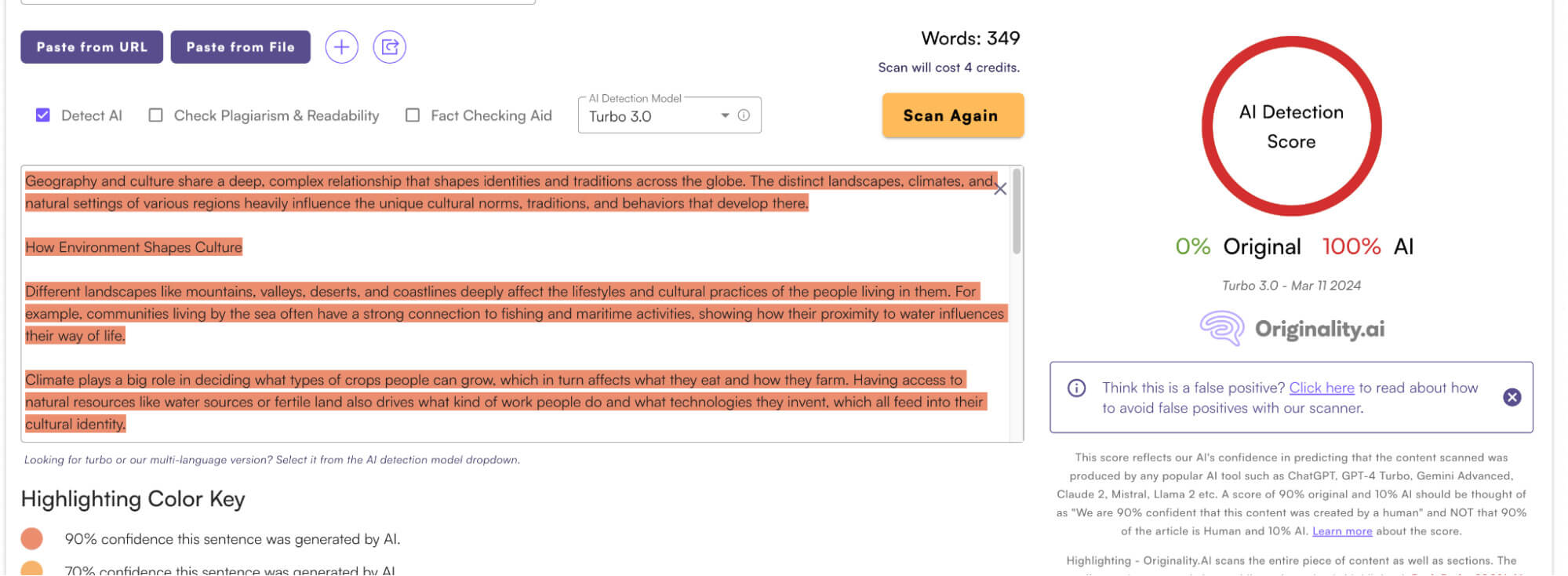
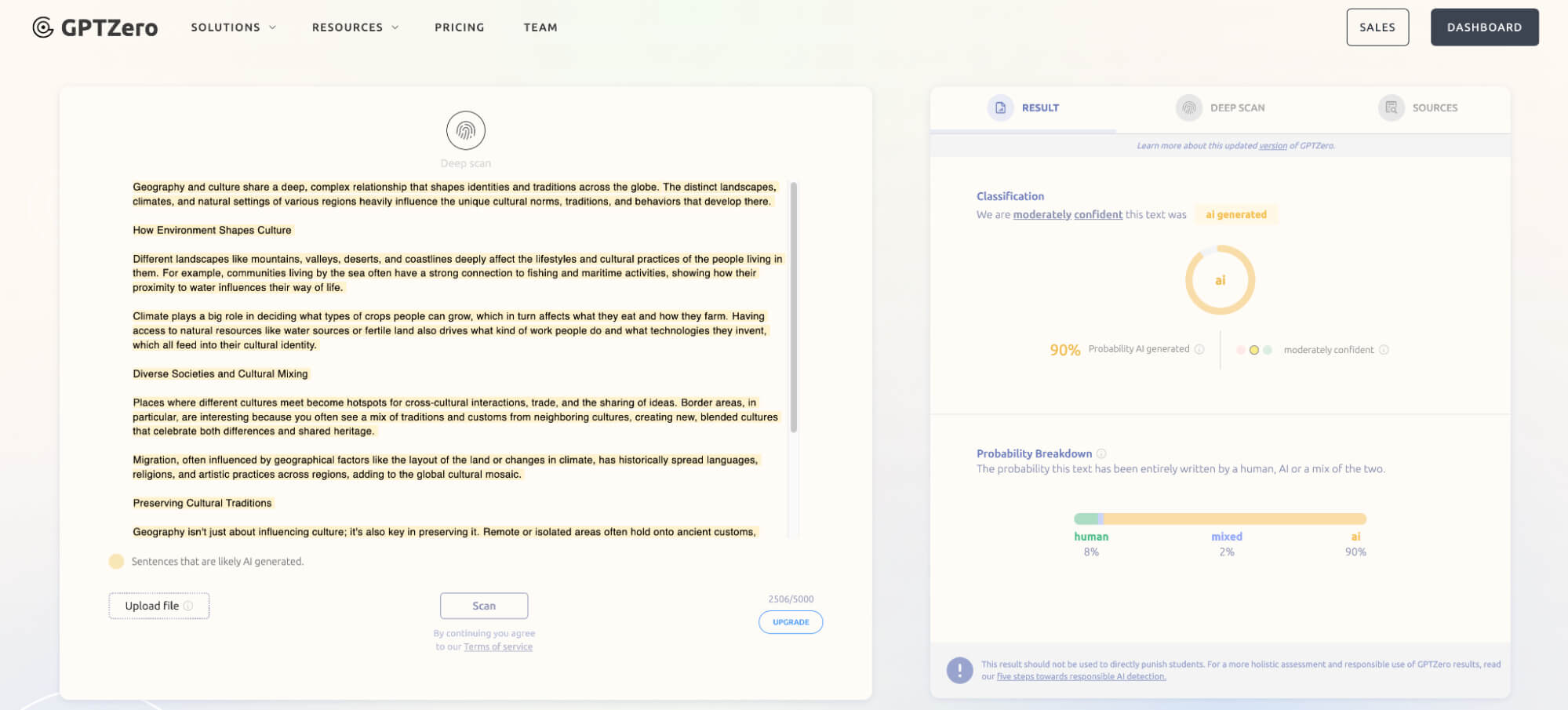
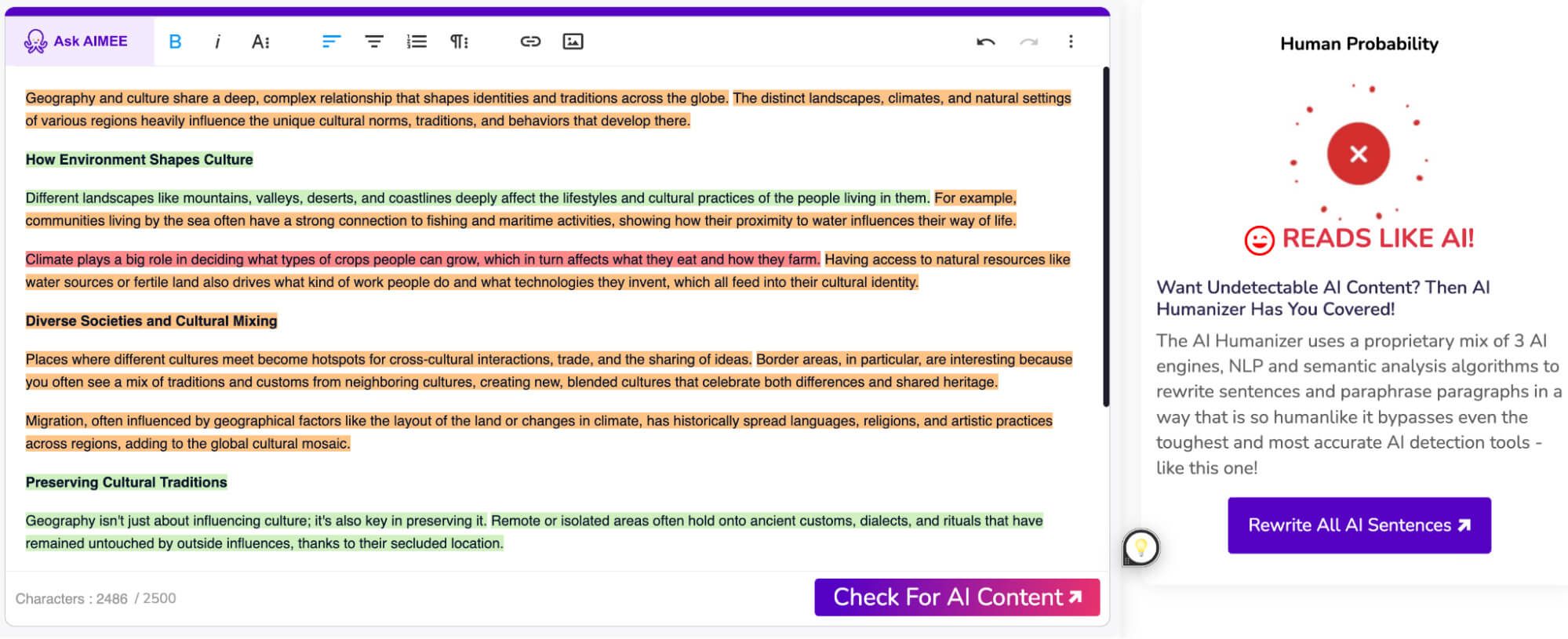
It seems like these changes aren't enough. All three AI detectors said that the processed content was still AI-generated.
This means that while using an active voice is a good idea for improving writing, it's not enough to make AI-generated content totally undetectable.
10. Add Unexpected Twists
Most articles created by AI tend to sound the same. There's nothing special or surprising about how they flow. That's where you can come in!
If your AI article feels a bit dull, you can make it more exciting by adding unexpected twists. This could be anything from unusual conclusions to surprising facts sprinkled throughout the article.
I added some freshness to the text: I explored how extreme climates inspire new cooking ideas and the surprising variety of languages spoken in coastal communities.
These changes can make the content richer and highlight how geography and culture are connected.
Here's the revised version of the article:
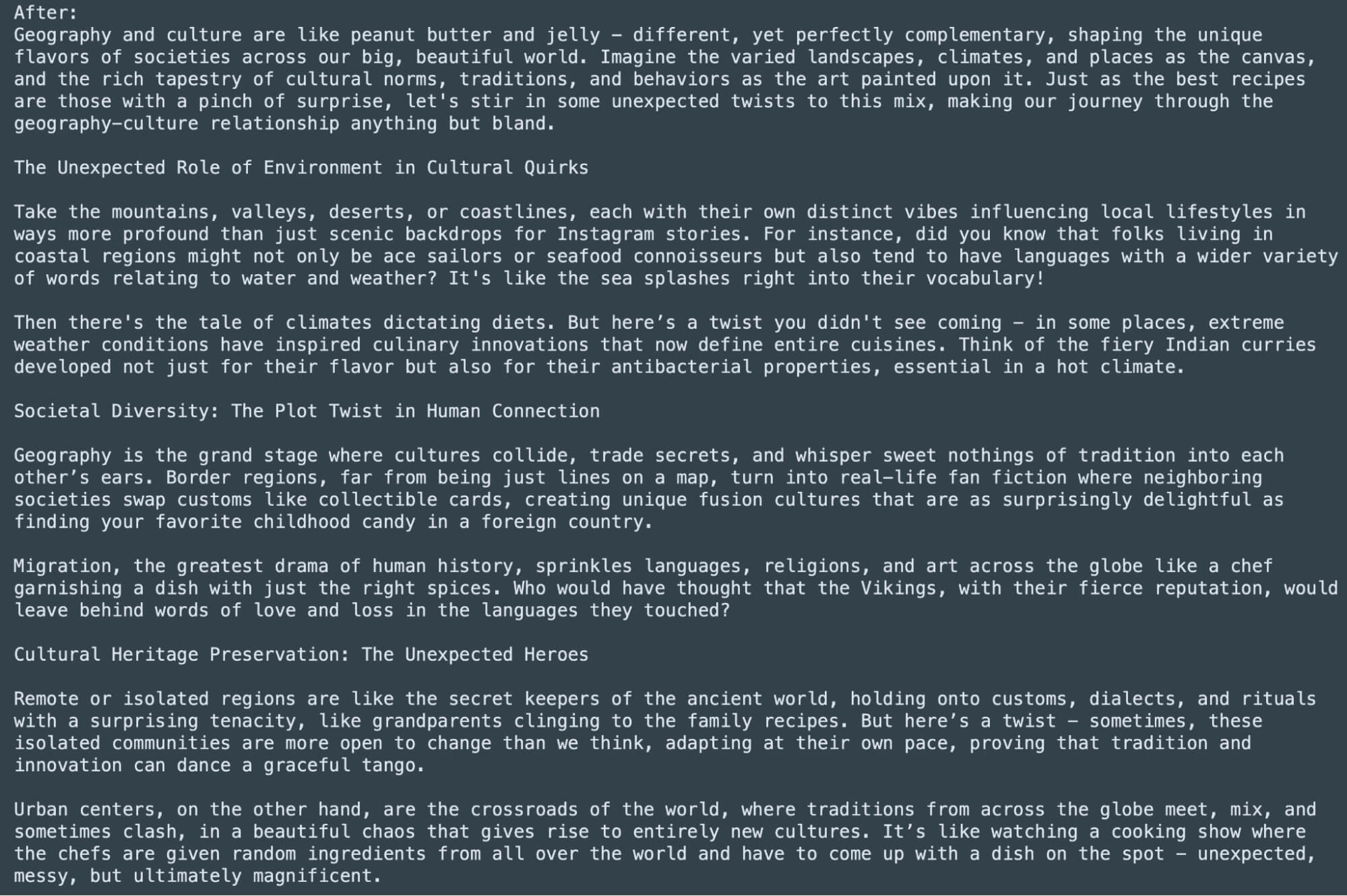
And here are the test results of this revision:
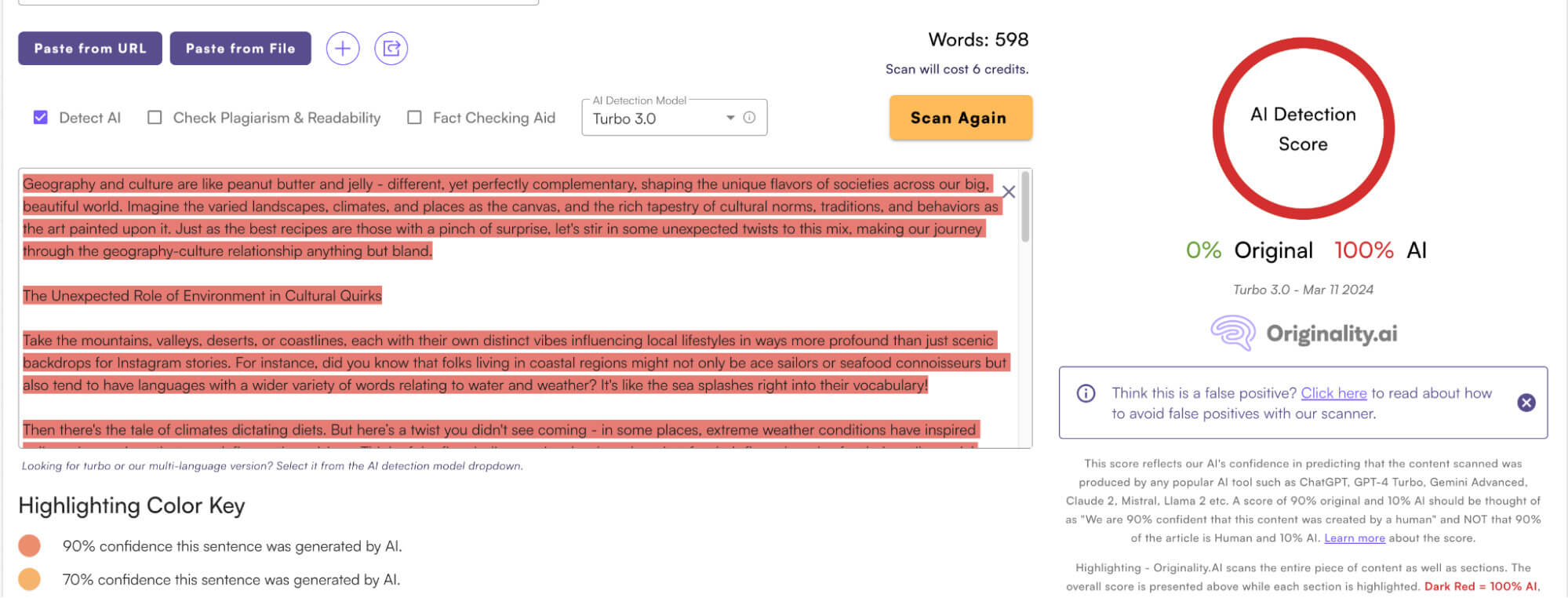
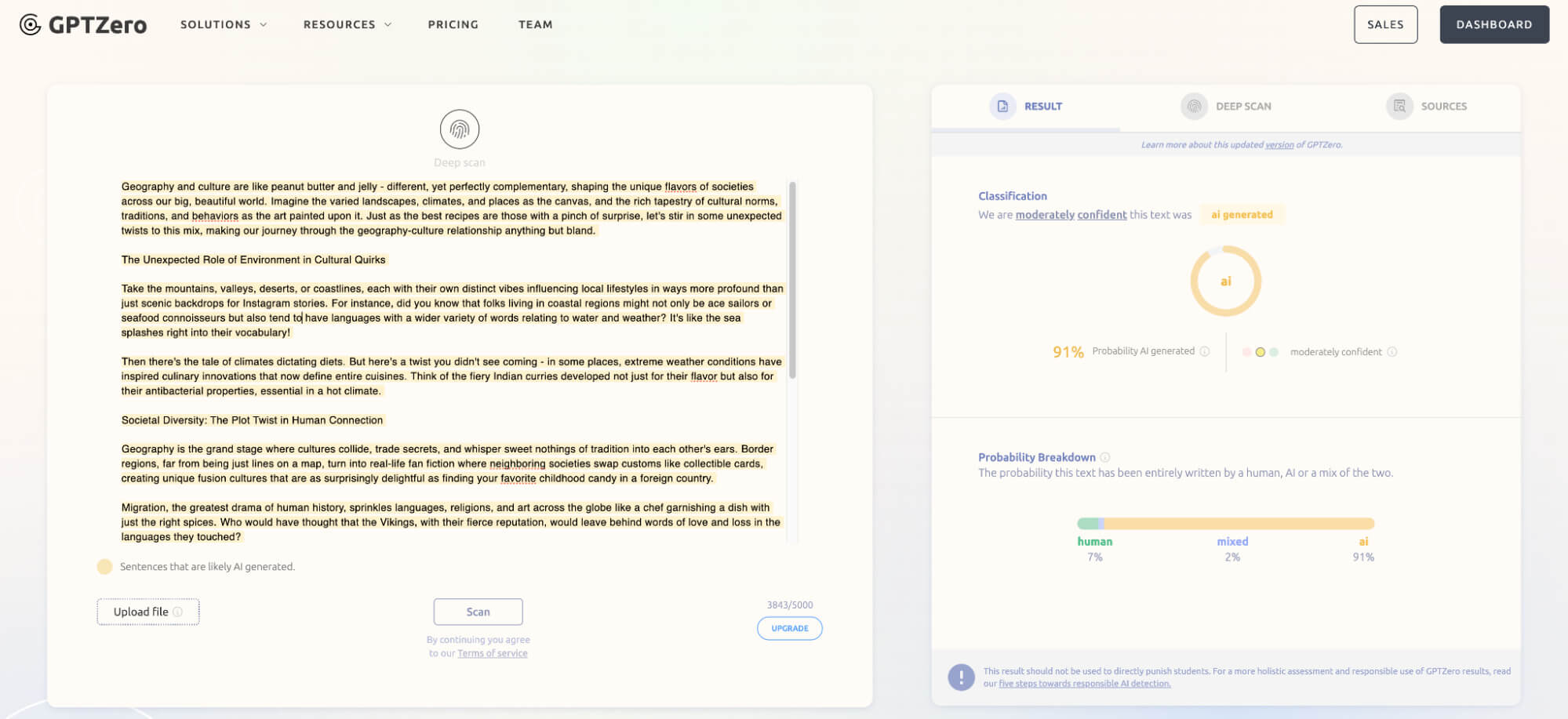
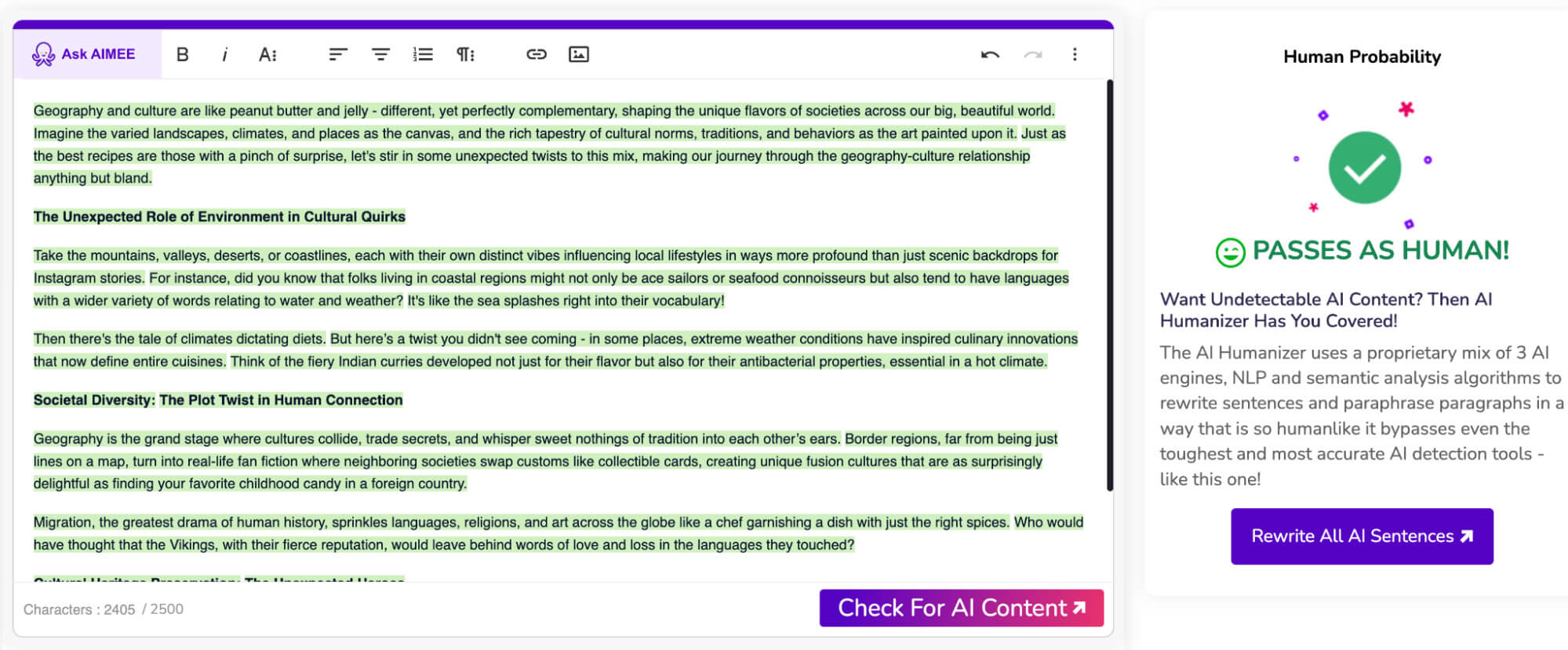
From our results, this approach seems to be working for Content at Scale, as the content passes as fully human according to that detector. However, for the other two detectors, the content is still flagged as AI-generated.
Why Bypass AI Detection?
You might be wondering, why should I bother trying to bypass AI detection at all? Why go through all that hassle? I'll share some insights with you!
Keep Your Content Visible (SEO)
For those of you out there creating content and using AI to help, one of the first things to think about is how search engines like Google treat AI-generated content. It's a big deal!
I've seen reports from users on social media saying that Google is really cracking down on low-quality content that's made just to trick search engines.
Imagine putting in all that effort and then finding out your website's traffic just plummeted because you used AI-written content. It's frustrating, right?
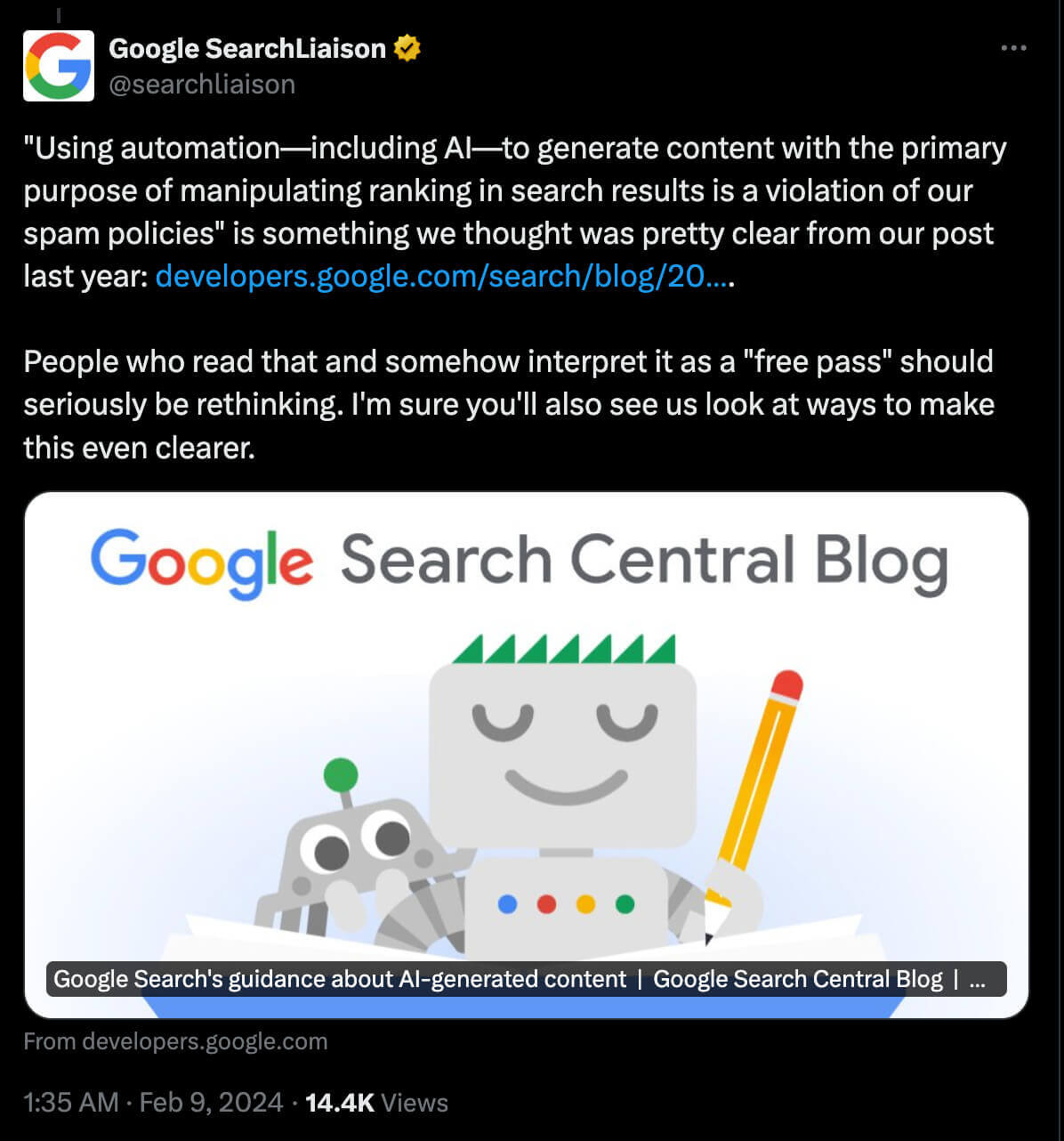
The good news is, Google has said they won't penalize helpful and informative content, no matter how it was created. So, if you're sharing valuable information, you're on the right track!
But here's the catch: Google knows how you made your content and what it's for, and they care about whether readers enjoy it.
Over the years, they've put in a lot of effort to figure out what people actually like to read. If your content makes it through Google's checks but feels useless or robotic to the readers, there's a good chance Google will still hit you with a penalty.
So, you really need to focus not just on making your content useful for search engines but also on connecting with your readers. Whether you're using AI for writing help or creating everything with AI, making it relatable is key!
In addition to making your content informative and practical, think about how to give it a more human touch. When your writing sounds natural and friendly, readers are more likely to stick around and engage with it. This can help you avoid those frustrating ranking drops and other SEO headaches.
Content Scrutiny & Quality
You might have noticed that many websites and platforms now use AI checkers to sniff out AI-generated content. This is happening in schools and writing agencies too, where they want to ensure that only original, human-created work gets submitted.
You might be thinking about rewriting your AI-generated content to try to fool the AI detectors. I get it; it sounds like a smart move.
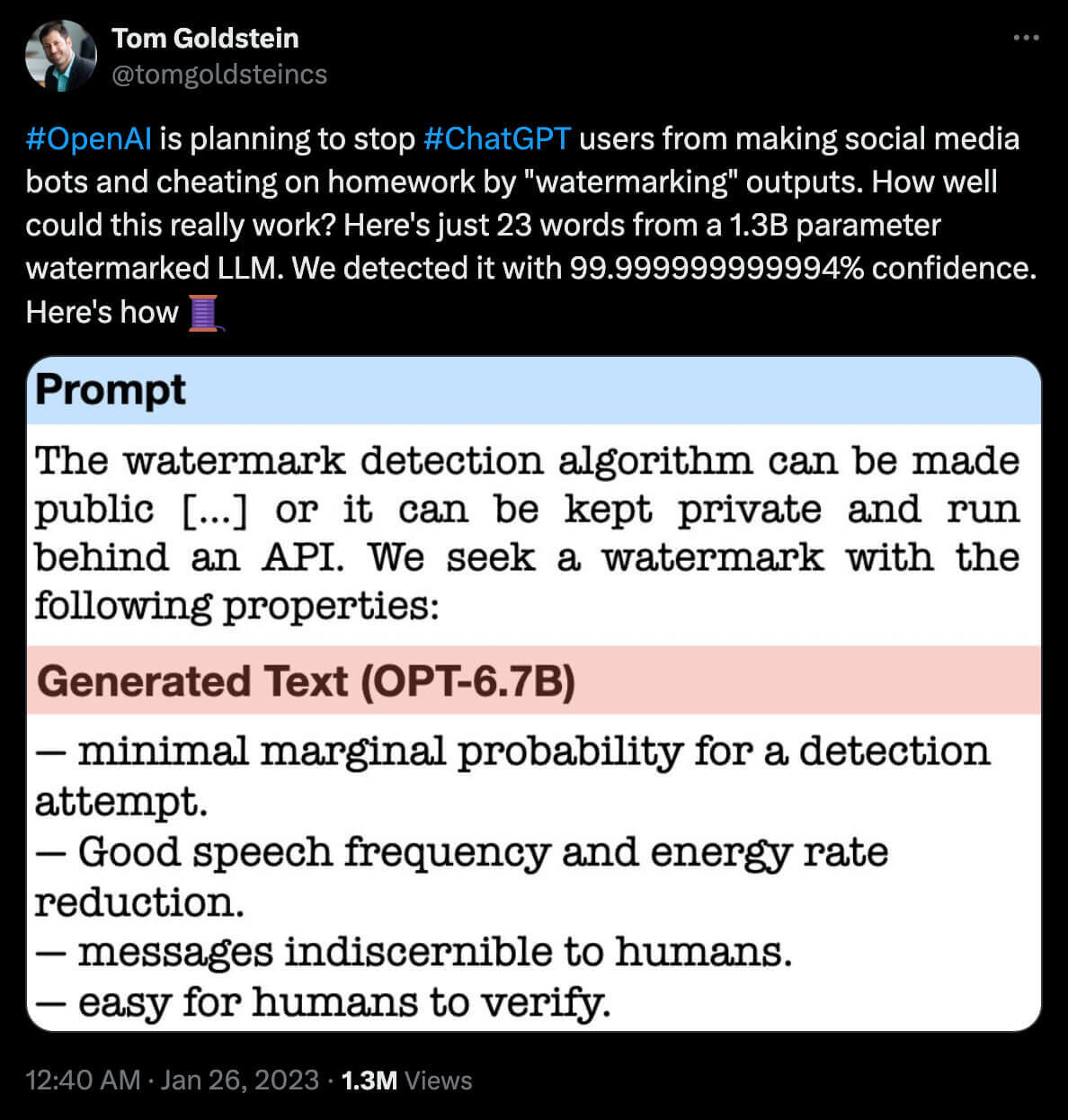
But unfortunately, this might not work as well as you hope. There have been reports that AI tools like ChatGPT leave watermarks in the content, making it easier for detectors to catch AI writing. That means it can be tricky to hide those “AI signs” in your text.
And here's something else to consider: these “accurate” AI detectors sometimes make mistakes. They might flag perfectly good, human-written content as AI-generated!
That's a real headache for content creators. I've read complaints about how Originality.ai and GPTZero can sometimes get it wrong, and it's clear that this is a problem.
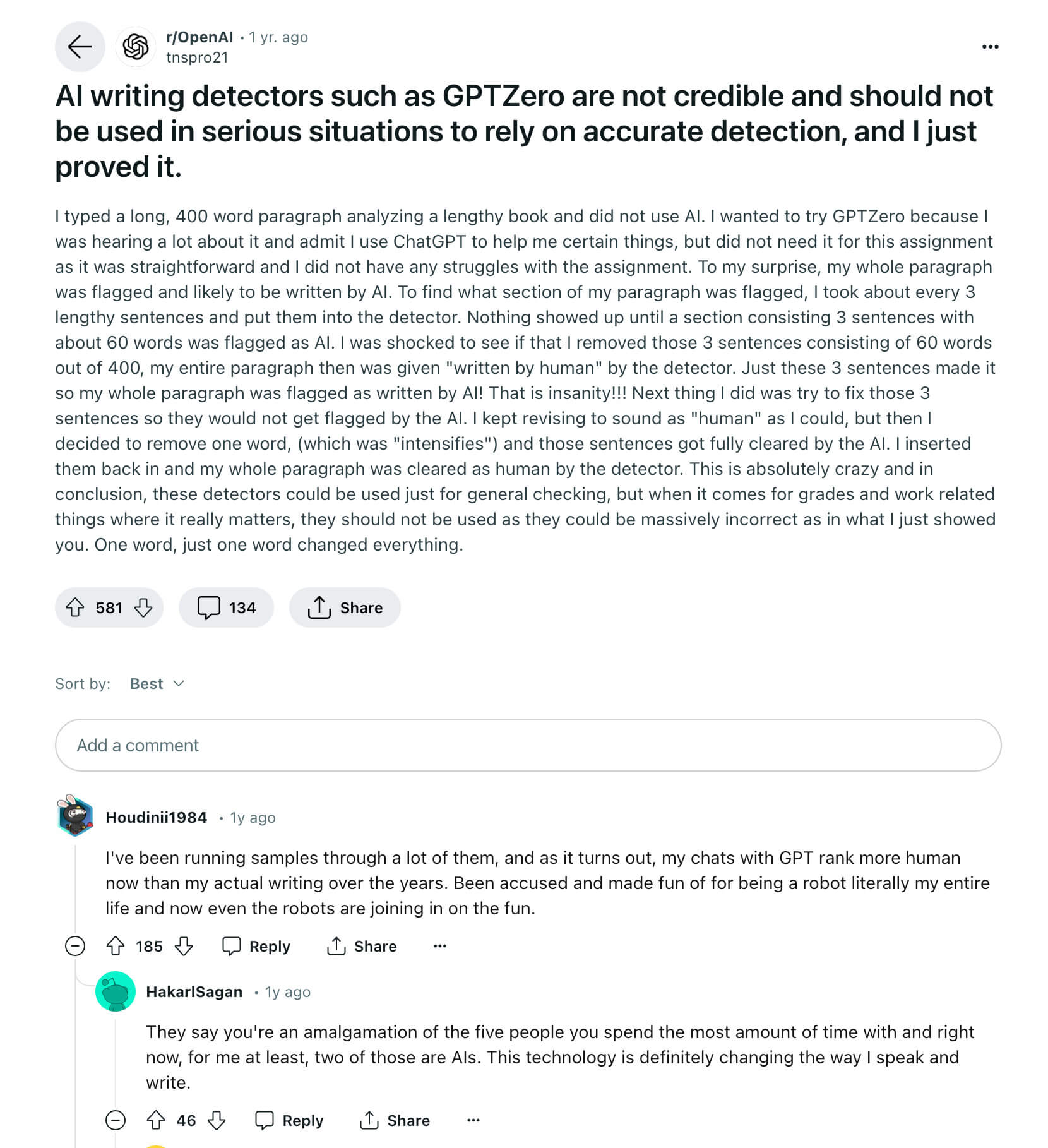
Source: https://www.reddit.com/r/OpenAI/comments/12oj9co/ai_writing_detectors_such_as_gptzero_are_not/
And there's more:
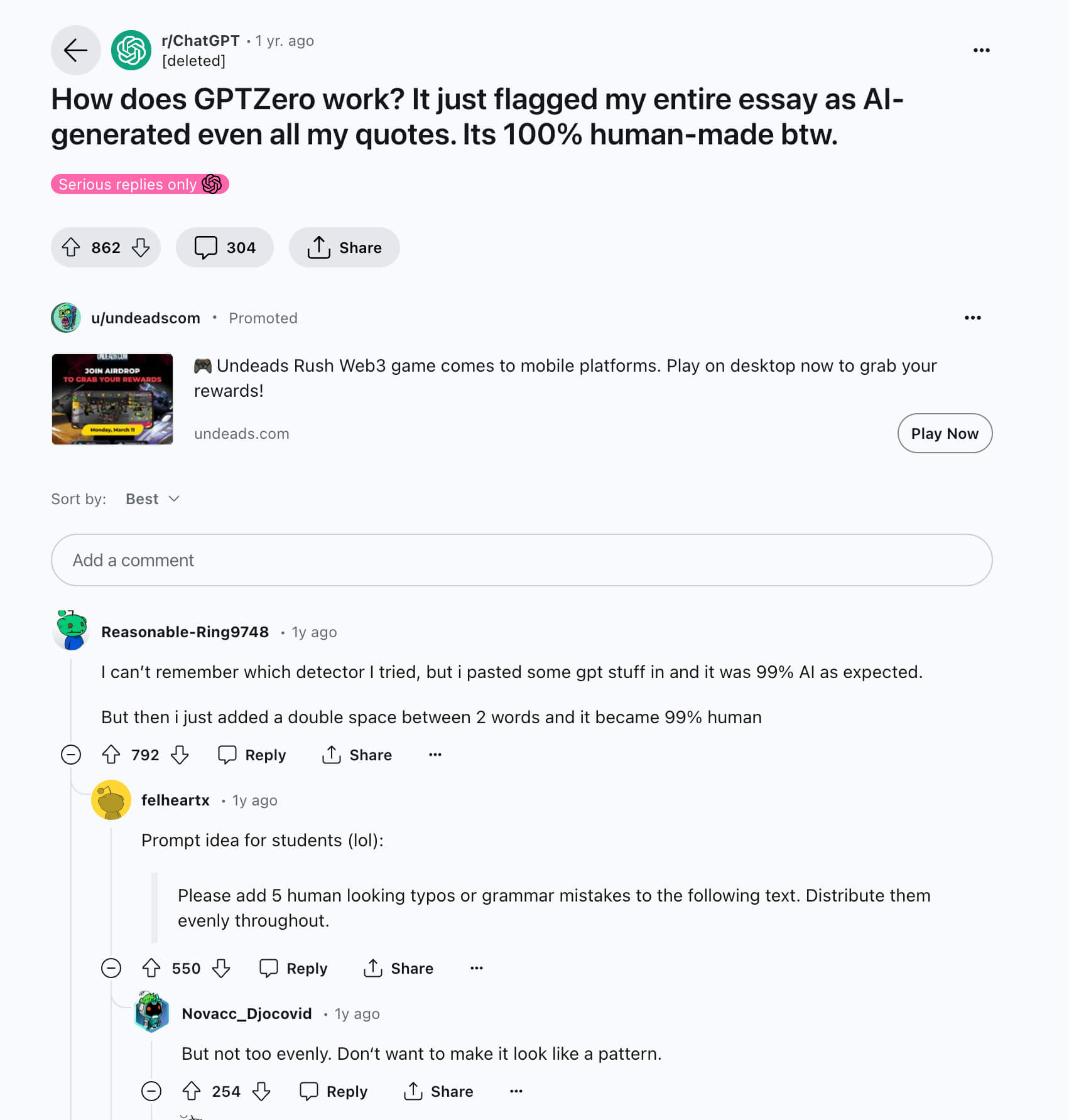
Source: https://www.reddit.com/r/ChatGPT/comments/126g3or/how_does_gptzero_work_it_just_flagged_my_entire/
That's why it's becoming super important for students, teachers, and content creators like you and me to learn how to make AI-generated text undetectable. By doing this, we can protect the quality of our content and avoid any potential issues that come with using AI in our writing process.
Produce Quality Content in Bulk
Let's be honest: AI writing tools can whip up content way faster and in bigger amounts than we humans can.
If you need to create a lot of content quickly, you might run into trouble with AI detector tools trying to catch you.
But don't let that put you off! The benefits of using AI writing tools are really worth it. Even if you spend some time figuring out how to bypass those AI detectors, you'll end up saving time and effort in the long run!
“AI-Proof” Your Content With BypassGPT
Since AI is so good at creating content, being able to bypass detection is an important skill for anyone who writes. This guide has shown you how to manually bypass AI detection, which can help you dodge those detectors.
But to be honest, manually tweaking every piece of content might not be the best option if you're aiming for efficiency and high-quality work.
If you want to make your content sound more human while still keeping up with the speed of AI, then you should definitely check out an AI humanizer like BypassGPT.
With BypassGPT, your writing will have that charming human touch that can easily trick those AI detectors, and it won't take much effort on your part!
So why not give BypassGPT a try today for free? You can “AI-proof” your content in no time and keep your writing engaging and relatable.